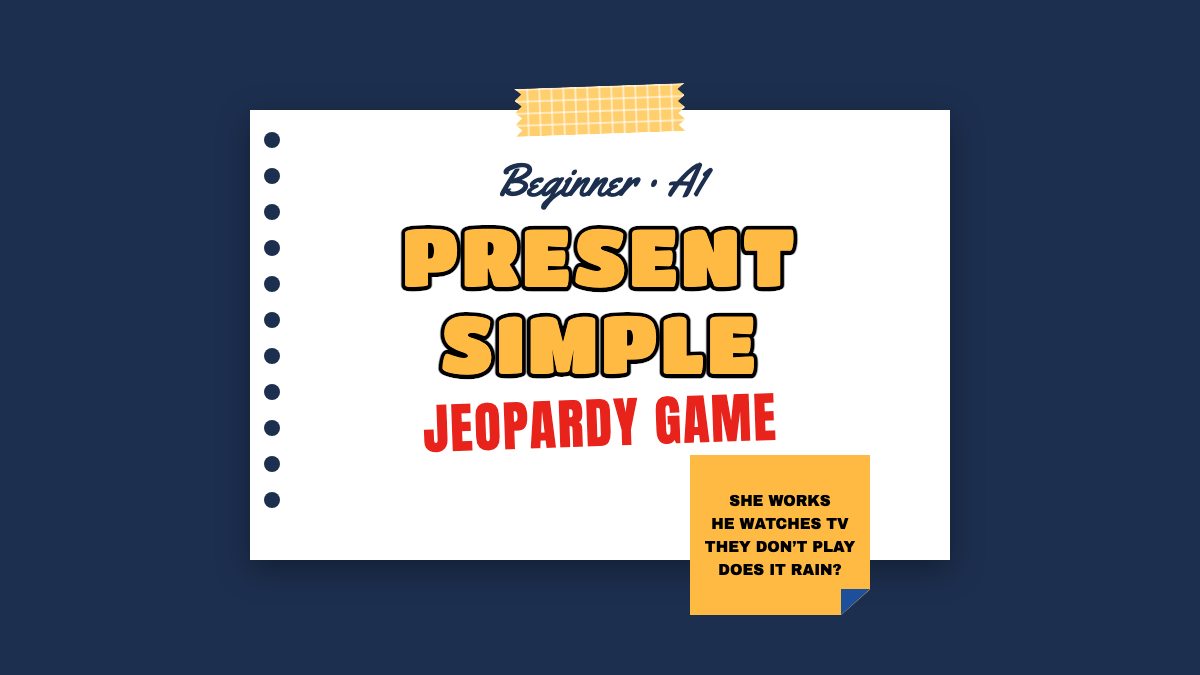
This present simple jeopardy game gives beginner (A1) learners 56 free questions on the present simple: negatives with don’t and doesn’t, Mr Black’s daily routine, and mixed practice with questions, -s and -es. Play it alone or with your class, then check the time expressions guide for the words that go with each tense.
Table of Contents
Present Simple Jeopardy Game: Play Now
How many teams are playing?
Choose 1 to 6 teams. You can play alone, in pairs of teams, or with the whole class.
- Pick a tile: the bigger the number, the harder the question.
- You have 20 seconds. The timer is separate from the answers and the Reveal answer button.
- Click an answer. Right answer: the team wins the points. Wrong answer: the next team gets one try. If it is wrong too, the answer is shown.
Answer Key: Present Simple Jeopardy Questions
Category 1
-
100 points: Choose the correct negative form. Jim ______ his horse in the park. He rides his bike.
- don’t ride
- doesn’t rides
- doesn’t ride
Answer: C. Jim is he, so we use doesn’t + base form: doesn’t ride.
-
200 points: Choose the correct present simple form. My neighbours ______ (not/get) on very well.
- doesn’t get
- don’t gets
- don’t get
Answer: C. My neighbours are they, so we use don’t + base form: don’t get.
-
300 points: Choose the right option. He ______ the dog before leaving home.
- walkes
- walk
- walks
Answer: C. With he we add -s to the verb: walk → walks.
-
400 points: Choose the correct negative form. The students ______ to school. They go to school by bus.
- doesn’t walk
- don’t walks
- don’t walk
Answer: C. The students are they, so we use don’t + base form: don’t walk.
-
500 points: Choose the correct present simple form. It often ______ (rain) in England.
- rain
- rains
- raining
Answer: B. With it the verb takes -s: rains.
-
600 points: Choose the right option. Then he ______ the floor.
- sweep
- sweps
- sweeps
Answer: C. With he we add -s to the base form: sweep → sweeps.
-
700 points: Choose the correct present simple form. The sun ______ (rise) in the east.
- rise
- rises
- rising
Answer: B. This is a fact, and the sun is it, so the verb takes -s: rises.
Category 2
-
100 points: Choose the right option. The alarm clock ______. Time to get up.
- ring
- rings
- ringes
Answer: B. The alarm clock is it, so the verb takes -s: rings.
-
200 points: Choose the correct negative form. Pam and Peter ______ yoga at weekends. They do judo.
- doesn’t do
- don’t do
- don’t does
Answer: B. Pam and Peter are they, so we use don’t + base form: don’t do.
-
300 points: Choose the correct present simple form. Brian always ______ (take) the train to work.
- take
- takes
- taking
Answer: B. Brian is he, so the verb takes -s: takes.
-
400 points: Choose the right option. He ______ back home.
- ride
- rides
- rodes
Answer: B. With he we add -s to the base form: ride → rides.
-
500 points: Choose the correct negative form. Dad ______ his hair after dinner. He brushes his teeth.
- don’t brush
- doesn’t brush
- doesn’t brushes
Answer: B. Dad is he, so we use doesn’t + base form: doesn’t brush.
-
600 points: Choose the correct present simple form. ______ (it/rain) where you live?
- Do it rain
- Does it rain
- Does it rains
Answer: B. With it the question uses Does + base form: Does it rain?
-
700 points: Choose the correct present simple form. Peter ______ (live) in a house in the country.
- live
- living
- lives
Answer: C. Peter is he, so the verb takes -s: lives.
Category 3
-
100 points: Choose the correct present simple form. Bill often ______ (take) his dog to the park.
- take
- takes
- taking
Answer: B. Bill is he, so the verb takes -s: takes.
-
200 points: Choose the right option. Then he ______ a shower.
- has
- have
- haves
Answer: A. Have is irregular: with he, she and it it becomes has.
-
300 points: Choose the correct negative form. The women ______ swimming at Christmas. They go shopping.
- don’t go
- doesn’t go
- don’t goes
Answer: A. The women are they, so we use don’t + base form: don’t go.
-
400 points: Choose the correct present simple form. ______ (you/speak) Spanish?
- Do you speak
- Does you speak
- Do you speaks
Answer: A. With you the question uses Do + base form: Do you speak?
-
500 points: Choose the right option. His wife always ______ TV in the morning.
- watches
- watch
- watching
Answer: A. Verbs ending in -ch take -es with he, she and it: watch → watches.
-
600 points: Choose the right option. Before going to bed he ______ a cigarette.
- smoke
- smoks
- smokes
Answer: C. With he we add -s to the full verb: smoke → smokes.
-
700 points: Choose the correct present simple form. Bob ______ (want) to buy the house.
- wants
- want
- wanting
Answer: A. Bob is he, so the verb takes -s: wants.
Category 4
-
100 points: Choose the correct negative form. Sally ______ a shower in the morning. She has a bath.
- doesn’t have
- don’t have
- doesn’t has
Answer: A. Sally is she, so we use doesn’t + base form: doesn’t have.
-
200 points: Choose the correct present simple form. Emma and Ian ______ (not/be) married yet.
- aren’t
- don’t be
- isn’t
Answer: A. Be does not use don’t. Emma and Ian are they, so we say aren’t.
-
300 points: Choose the right option. He ______ to the park.
- run
- rans
- runs
Answer: C. With he we add -s to the base form: run → runs.
-
400 points: Choose the correct negative form. Alex ______ comics in summer. He reads books.
- don’t read
- doesn’t reads
- doesn’t read
Answer: C. Alex is he, so we use doesn’t + base form: doesn’t read.
-
500 points: Choose the correct present simple form. Where ______ (Bill/take) his dog?
- do Bill take
- does Bill takes
- does Bill take
Answer: C. Bill is he, so the question uses does + base form: does Bill take?
-
600 points: Choose the correct present simple form. Water ______ (boil) at 100°C.
- boil
- boiling
- boils
Answer: C. This is a fact, and water is it, so the verb takes -s: boils.
-
700 points: Choose the correct present simple form. This cottage ______ (be) very nice.
- is
- are
- be
Answer: A. This cottage is singular, so be becomes is.
Category 5
-
100 points: Choose the right option. Mr. Black ______ a cup of coffee.
- drank
- drink
- drinks
Answer: C. The story is about his daily routine, so we use the present simple with -s for he: drinks.
-
200 points: Choose the correct negative form. Your brother ______ a blue car. He drives a red car.
- don’t drive
- doesn’t drives
- doesn’t drive
Answer: C. Your brother is he, so we use doesn’t + base form: doesn’t drive.
-
300 points: Choose the correct present simple form. ______ (your friends/smoke)?
- Does your friends smoke
- Do your friends smokes
- Do your friends smoke
Answer: C. Your friends are they, so the question uses Do + base form: Do your friends smoke?
-
400 points: Choose the right option. He ______ the flowers.
- water
- waters
- wateres
Answer: B. With he we add -s, not -es: water → waters.
-
500 points: Choose the right option. After lunch she ______ to town.
- drives
- drive
- droves
Answer: A. With she we add -s to the base form: drive → drives.
-
600 points: Choose the right option. He ______ to bed at midnight.
- goes
- gos
- go
Answer: A. Go takes -es with he, she and it: go → goes.
-
700 points: Choose the correct present simple form. Emma ______ (have) got a new bike.
- have
- has
- having
Answer: B. Emma is she, so have becomes has: has got.
Category 6
-
100 points: Choose the correct present simple form. ______ (Polly/need) a new computer?
- Do Polly need
- Does Polly need
- Does Polly needs
Answer: B. Polly is she, so the question uses Does + base form: Does Polly need?
-
200 points: Choose the right option. He ______ his hair.
- combes
- combs
- comb
Answer: B. With he we add -s to the verb: comb → combs.
-
300 points: Choose the correct negative form. Autumn ______ in August. It starts in September.
- don’t start
- doesn’t start
- doesn’t starts
Answer: B. Autumn is it, so we use doesn’t + base form: doesn’t start.
-
400 points: Choose the correct present simple form. Mary ______ (not/like) tea.
- don’t like
- doesn’t like
- doesn’t likes
Answer: B. Mary is she, so we use doesn’t + base form: doesn’t like.
-
500 points: Choose the correct present simple form. They ______ (like) going for walks in the country.
- like
- likes
- liking
Answer: A. With they we use the base form, with no -s: like.
-
600 points: Choose the correct present simple form. Jane ______ (love) her new job.
- love
- loving
- loves
Answer: C. Jane is she, so the verb takes -s: loves.
-
700 points: Choose the correct present simple form. I ______ (not/like) sport.
- doesn’t like
- don’t likes
- don’t like
Answer: C. With I we use don’t + base form: don’t like.
Category 7
-
100 points: Choose the correct negative form. John ______ up at quarter past seven. He gets up at six o’clock.
- don’t get
- doesn’t get
- doesn’t gets
Answer: B. John is he, so we use doesn’t + base form: doesn’t get.
-
200 points: Choose the correct present simple form. Sally ______ (practise) once a week.
- practises
- practise
- practising
Answer: A. Sally is she, so the verb takes -s: practises.
-
300 points: Choose the right option. He ______ the pigeons.
- feeds
- feds
- feed
Answer: A. With he we add -s to the base form: feed → feeds.
-
400 points: Choose the correct negative form. The mechanics ______ bikes here. They repair cars.
- don’t repair
- doesn’t repair
- don’t repairs
Answer: A. The mechanics are they, so we use don’t + base form: don’t repair.
-
500 points: Choose the right option. Mr Black ______ in the afternoon.
- painting
- paints
- paint
Answer: B. Mr Black is he, so the verb takes -s: paints.
-
600 points: Choose the correct present simple form. Betty and Sue often ______ (go) shopping together.
- go
- goes
- going
Answer: A. Betty and Sue are they, so we use the base form: go.
-
700 points: Choose the correct present simple form. ______ (you/drive) to work?
- Does you drive
- Do you drives
- Do you drive
Answer: C. With you the question uses Do + base form: Do you drive?
Category 8
-
100 points: Choose the right option. He ______ some exercise.
- does
- do
- make
Answer: A. We say do exercise, and with he do becomes does.
-
200 points: Choose the correct negative form. He ______ tennis after lunch. He plays football.
- doesn’t play
- don’t play
- doesn’t plays
Answer: A. With he we use doesn’t, and the verb after it has no -s: doesn’t play.
-
300 points: Choose the correct present simple form. David ______ (work) in a bank.
- work
- working
- works
Answer: C. David is he, so the verb takes -s: works.
-
400 points: Choose the right option. Then he ______ his lunch.
- prepare
- prepars
- prepares
Answer: C. With he we add -s to the full verb: prepare → prepares.
-
500 points: Choose the correct present simple form. They often ______ (take) part in charity walks.
- take
- takes
- taking
Answer: A. With they we use the base form, with no -s: take.
-
600 points: Choose the correct present simple form. My father ______ (not/read) much.
- don’t read
- doesn’t read
- doesn’t reads
Answer: B. My father is he, so we use doesn’t + base form: doesn’t read.
-
700 points: Choose the correct present simple form. Where ______ (Paul/live)?
- does Paul live
- do Paul live
- does Paul lives
Answer: A. Paul is he, so the question uses does + base form: does Paul live?
What Is the Present Simple?
Quick answer: the present simple is the tense for habits, routines and facts: I play tennis. Cats like milk. The sun rises in the east. With he, she and it the verb takes -s or -es (she works, he watches). Negatives use don’t / doesn’t + base form, and questions use do / does + base form.
The 56 questions in this game practise exactly these points. Every question has three choices, and only one of them is correct.
How to Play the Present Simple Jeopardy Game
- Choose 1 to 6 teams. You can play alone, with 2 teams or with the whole class.
- Teams take turns to pick a tile. The bigger the number, the harder the question.
- Click one answer. The 20-second timer has Pause and Restart buttons, and you can still answer or reveal the answer when the time is up.
- A right answer wins the points. After a wrong answer, the next team gets one try with the two choices left. If that is wrong too, the question ends and the answer is shown, with no points.
- The Reveal answer button shows the correct answer and a short explanation, with no points.
- A tile disappears after its question is closed. Use the -100 button to give a penalty and the Full screen button to play on a projector.
Present Simple Rules for the Game
When Do We Use the Present Simple?
| Use | Example |
|---|---|
| Repeated actions | I play tennis. |
| Facts or generalizations | Cats like milk. |
| Scheduled events in the future | The film starts at 8. |
| State verbs (non-continuous verbs) | She needs help. |
How Do We Form the Present Simple?
| Form | Examples |
|---|---|
| Verb + s or es in the third person | I play tennis every Saturday. She often watches television. He speaks English. |
| Do or does + base form for questions | Do you like chocolate? Does she speak Italian? |
| Don’t or doesn’t + base form for negatives | They don’t live in London. He doesn’t drink tea. |
Where Do Adverbs of Frequency Go?
Adverbs such as always, never, often, sometimes, rarely, ever, still, just and only go:
- Before the verb: You only speak English. Do you still live in London?
- After the verb to be: I’m never late. He’s often busy.
Tips for the Present Simple Jeopardy Game
- Find the subject first. He, she, it or one person or thing (Bill, the sun, my father) means -s on the verb.
- One -s only. After does or doesn’t the verb has no -s: Does she speak? not Does she speaks?
- -es after ch, sh, ss, x and o: watches, brushes, goes, does.
- Be and have are different. Say They aren’t married (not don’t be) and She has a bike (not haves).
- Look for routine words. Always, often, every day and at weekends tell you to use the present simple.
- For more examples, see the present simple page on British Council LearnEnglish.
Frequently Asked Questions
When do we add -s to the verb in the present simple?
We add -s only with he, she and it (or one person or thing): she works, it rains, Bill takes. With I, you, we and they there is no -s: they work.
When do we add -es instead of -s?
Verbs that end in -ch, -sh, -ss, -x or -o take -es: watches, brushes, misses, fixes, goes, does. Have is irregular: has.
How do we make negatives in the present simple?
Use don’t or doesn’t + the base form of the verb. Doesn’t is for he, she and it: He doesn’t play tennis. The verb after doesn’t never takes -s.
How do we ask questions in the present simple?
Use do or does + subject + base form: Do you speak Spanish? Does Polly need a new computer? With the verb be, we do not use do: Is she married?
Can I play this present simple jeopardy game alone?
Yes. Choose 1 team on the start screen and try to get the maximum score. In class, you can play with 2 to 6 teams on a big screen.
- Verb Tenses Exercises with Answers
- Time Expressions: Tenses Guide with Examples
- Verbs Not Used in the Continuous
- More free English games
- Present Perfect vs Simple Past Jeopardy Game
Level: A1 · See more Beginner exercises