This lesson on prepositions of time and place starts with a short text about a school clean-up day and ends with your own announcement, in 10 exercises with instant answers: find the rule, choose at, on or in, tell since from for and until from by, read a park map and correct typical mistakes. It belongs to the same Unit 4 (Environment and Ecology) as our too and enough lesson and goes well with the sustainable development vocabulary exercises.
In this exercise page
Prepositions of time and place: 10 exercises with answers
Prepositions of time and place practice: 10 exercises with 61 auto-checked questions: find the rule · at, on or in · since, for, until, by · confusing pairs · map · write and speak
Need help? Prepositions of time and place in one minute
- Time: at + clock times (at 8 o’clock), on + days and dates (on 5th June), in + months, years, seasons, parts of the day (in the morning).
- since + a starting point (since 2020), for + a length of time (for four hours), until = up to that time, by = not later than.
- Place: in + inside a space, on + a surface or street, at + a specific point (at the school gate).
- between two things, among a group; under = directly beneath, below = at a lower level; over = covering or across, above = higher, not touching.
Full lesson with examples: prepositions of time and prepositions of place.
Read: Green Day at Our School (open answers)
Every year, on 5th June, our school celebrates World Environment Day. This year, the clean-up started at 8 o'clock in the morning and lasted until noon. We met at the school gate, next to the library. Our school has had a recycling club since 2020, and its members worked for four hours. During the morning, we collected plastic in the yard and on the football field. Volunteers put new bins between the classrooms and the canteen, and a big poster on the wall in front of the main building. At 10 o'clock, we drank juice under the old olive tree, while birds sang among its branches above our heads. Before the campaign, the river behind our school was full of plastic; after it, the water looked clean again. Our teacher wants our photos by Friday. The next clean-up will be in two weeks.
Quick questions:
When did the clean-up start and finish?
Model answer
It started at 8 o'clock and finished at noon.
Where did the students meet?
Model answer
At the school gate, next to the library.
Task 1: Underline every preposition in the text. Then sort them with the word that follows. (2 questions)
Time (When?) — on 5th June, … (12 prepositions)
Place (Where?) — at the school gate, … (11 prepositions)
Task 2: Complete the rule box. (9 questions)
TIME
______ + clock times, festivals, night, the weekend (8 o'clock, Eid)
______ + days and dates (Monday, 5th June)
______ + months, years, seasons, parts of the day, a period in the future (June, 2030, summer, the morning, two weeks)
since 2020 → since + a ______ point
for four hours → for + a ______ of time
• until noon → the action continues up to that time
by Friday → not ______ than Friday
PLACE
______ + inside a space, cities, countries (the yard, Agadir, Morocco)
______ + a surface, streets, floors (the wall, the football field, Hassan II Street)
______ + a specific point (the school gate, the bus stop, home)
Match: Match each preposition to its meaning. (10 questions)
Each preposition (1–10) matches ONE meaning from the whole list (a–j). Write the letter.
- a. in the middle of two
- b. close, but not side by side
- c. directly beneath, often touching
- d. directly above, covering or across
- e. higher, not touching
- f. at a lower level (levels, measurements)
- g. in the middle of a group (3 +)
- h. right at the side, nothing in between
- i. at the back
- j. facing, across a street or table
under
between
next to
above
over
below
among
near
opposite
behind
Exercise A: At, on or in? (10 questions)
The clean-up campaign starts ______ 9 a.m.
World Environment Day is ______ 5th June.
It is very hot in Marrakech ______ summer.
Many families go to the beach ______ the weekend.
The new park will open ______ 2027.
Some factories burn their waste ______ night.
We have a club meeting ______ Friday morning.
The project will finish ______ two weeks.
People visit their families ______ Eid.
We usually plant trees ______ March.
Exercise B: Choose: since – for – during – until – by – before – after (8 questions)
I have known Sara ______ 2019, the year we started primary school together.
The drought lasted ______ three years.
The lights went out twice ______ the film, so we missed some of the story.
The school library is open from 8 a.m. ______ 6 p.m.
Send me your photos ______ Friday. Friday is the last day you can send them.
Always look left and right ______ you cross the street.
______ the clean-up, the beach was clean again, so we took photos.
Mr Alaoui has taught at our school ______ ten years, and he still loves his job.
Exercise C: Circle the correct preposition. (8 questions)
The temperature fell ______ zero last night.
My little brother hid ______ the bed.
Put a blanket ______ the young plants to protect them from the cold.
The village is 2,000 metres ______ sea level.
The bus stop is ______ the bakery and the mosque.
There is a small house ______ the trees of the forest.
The bin is ______ the door. There is nothing in between.
We live ______ the beach. It's a five-minute walk.
Exercise D: Green Park — look at the map. (8 questions)
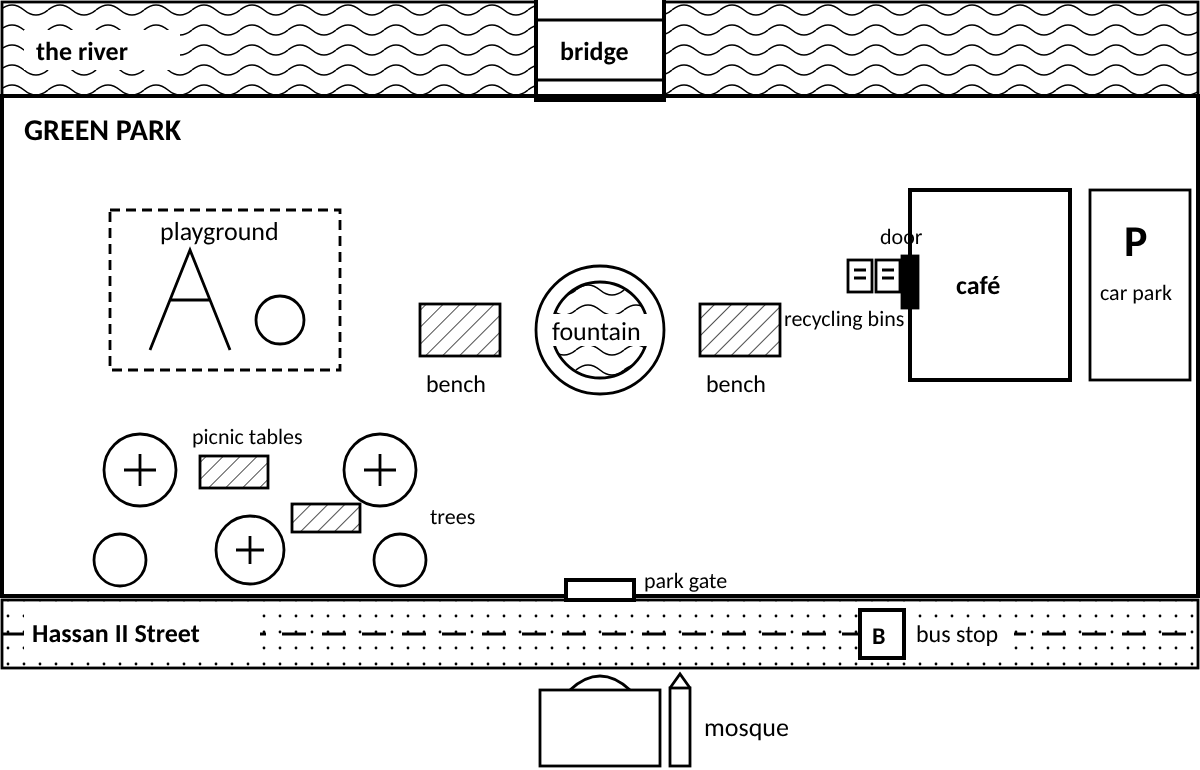
D1. Complete with a preposition of place.
The bridge goes ______ the river, from one side to the other.
The fountain is ______ the two benches.
The picnic tables are ______ the five trees.
The café is ______ the recycling bins and the car park.
The car park is ______ the café, on the side away from the door.
The bus stop is ______ Hassan II Street.
The mosque is ______ the park gate, across the street.
The playground is ______ the fountain, but not right beside it.
D2. “Where am I?” (pairs, oral)
Choose a place on the map. Describe where you are in two sentences. Your partner guesses. Example: I’m next to the door. The car park is behind me. → You’re in the café!
My two sentences:
Model answer
I’m between the two benches. The playground is near me. → You’re at the fountain!
Exercise E: Correct the mistakes. (6 questions)
The meeting is in Monday. →
I have lived in this town since five years. →
We clean the yard at the morning. →
The cat is sleeping below the car. →
Our house is among the school and the park. →
Please finish the project until Friday. →
Writing: Write a short announcement (open answers)
Your class is organizing a clean-up day in your town. Write a short announcement (5–7 sentences) for the school notice board. Say when it is, where to meet, how long it lasts, where to put the rubbish bags and the deadline for photos.
Sentences: 0 · Prepositions: 0
Checklist:
Model announcement
Join our clean-up day on Saturday, 12th April! We will meet at 9 a.m. at the park gate, opposite the mosque. The clean-up will last until noon. Put the full bags next to the recycling bins in front of the café. Let's make our town green! Please send your photos by Monday.
Exit ticket: One sentence of time, one of place (open answers)
Write one sentence with a preposition of time and one with a preposition of place about your school.
A sentence with a preposition of time:
Model answer
Our English class starts at 8 o'clock on Monday.
A sentence with a preposition of place:
Model answer
The library is next to the main gate of our school.
Answer Key
Quick questions
- It started at 8 o'clock and finished at noon.
- At the school gate, next to the library.
Task 1
- Time (12): on 5th June, at 8 o'clock, in the morning, until noon, since 2020, for four hours, during the morning, at 10 o'clock, before the campaign, after it, by Friday, in two weeks
- Place (11): at the school gate, next to the library, in the yard, on the football field, between the classrooms and the canteen, on the wall, in front of the main building, under the old olive tree, among its branches, above our heads, behind our school
Task 2: rule box
- at + clock times, festivals, night, the weekend (8 o'clock, Eid)
- on + days and dates (Monday, 5th June)
- in + months, years, seasons, parts of the day, a period in the future (June, 2030, summer, the morning, two weeks)
- since 2020 → since + a starting point
- for four hours → for + a length of time
- by Friday → not later than Friday
- in + inside a space, cities, countries (the yard, Agadir, Morocco)
- on + a surface, streets, floors (the wall, the football field, Hassan II Street)
- at + a specific point (the school gate, the bus stop, home)
Matching
- under → c (directly beneath, often touching)
- between → a (in the middle of two)
- next to → h (right at the side, nothing in between)
- above → e (higher, not touching)
- over → d (directly above, covering or across)
- below → f (at a lower level (levels, measurements))
- among → g (in the middle of a group (3 +))
- near → b (close, but not side by side)
- opposite → j (facing, across a street or table)
- behind → i (at the back)
Exercise A
- The clean-up campaign starts at 9 a.m.
- World Environment Day is on 5th June.
- It is very hot in Marrakech in summer.
- Many families go to the beach at the weekend.
- The new park will open in 2027.
- Some factories burn their waste at night.
- We have a club meeting on Friday morning.
- The project will finish in two weeks.
- People visit their families at Eid.
- We usually plant trees in March.
Exercise B
- I have known Sara since 2019, the year we started primary school together.
- The drought lasted for three years.
- The lights went out twice during the film, so we missed some of the story.
- The school library is open from 8 a.m. until 6 p.m.
- Send me your photos by Friday. Friday is the last day you can send them.
- Always look left and right before you cross the street.
- After the clean-up, the beach was clean again, so we took photos.
- Mr Alaoui has taught at our school for ten years, and he still loves his job.
Exercise C
- The temperature fell below zero last night.
- My little brother hid under the bed.
- Put a blanket over the young plants to protect them from the cold.
- The village is 2,000 metres above sea level.
- The bus stop is between the bakery and the mosque.
- There is a small house among the trees of the forest.
- The bin is next to the door. There is nothing in between.
- We live near the beach. It's a five-minute walk.
Exercise D1
- The bridge goes over the river, from one side to the other.
- The fountain is between the two benches.
- The picnic tables are among the five trees.
- The café is between the recycling bins and the car park.
- The car park is behind the café, on the side away from the door.
- The bus stop is on Hassan II Street.
- The mosque is opposite the park gate, across the street.
- The playground is near the fountain, but not right beside it.
Exercise E
- The meeting is on Monday.
- I have lived in this town for five years.
- We clean the yard in the morning.
- The cat is sleeping under the car.
- Our house is between the school and the park.
- Please finish the project by Friday.
Part 3 (sample announcement)
- Join our clean-up day on Saturday, 12th April! We will meet at 9 a.m. at the park gate, opposite the mosque. The clean-up will last until noon. Put the full bags next to the recycling bins in front of the café. Let's make our town green! Please send your photos by Monday.
Exit ticket (possible answers)
- Our English class starts at 8 o'clock on Monday.
- The library is next to the main gate of our school.
Download the prepositions of time and place activity sheet, or the teacher’s lesson plan with the answer key.
Tap an exercise to open it. In Task 1, tap the words in the text to underline them. Buttons and typed answers are checked at once; the open writing and speaking tasks have a model answer to compare with.
Prepositions of time and place lesson plan: teacher’s guide
Teachers can use this prepositions of time and place lesson plan as it is: it fits one 55-minute session with the student activity sheet above.
Lesson information
- Class: 1st Year Baccalaureate — Ticket to English 1, Unit 4: Environment and Ecology
- Structure: prepositions of time (at / on / in, since / for, during, until / by, before / after); prepositions of place (in / on / at, under / below, above / over, next to / beside / near, between / among, behind / in front of / opposite)
- Time: 45 minutes of teaching (a 55-minute session, minus time for late arrivals and the register)
- Materials: the student activity sheet (with the Green Park map for Exercise D), the board
- Interaction: whole class, individual, pairs, groups of 4
Goals and rationale
Students need prepositions to say when and where environmental action happens: organizing a clean-up, describing a place, setting deadlines. They are also a common source of errors because of L1 transfer: French depuis gives *since five years*, and Arabic fi leads to overusing in (*in Monday*).
Objectives
By the end of the lesson, students will be able to:
- state in their own words when to use at / on / in for time and for place (skill level);
- choose the correct preposition in gap-fill and multiple-choice items, getting at least 8 out of 10 right (capability level);
- tell the difference between since / for, until / by, under / below, above / over, between / among and next to / near (capability level);
- write a 5–7 sentence announcement for a clean-up day using at least 3 time and 3 place prepositions correctly (competency level).
Stages at a glance
- Stage 1: Presentation and comprehension check — skill level — 13 min
- Stage 2: Practice in new contexts — capability level — 19 min
- Stage 3: Use and application — competency level — 9 min
- Stage 4: Wrap-up and evaluation — 4 min
Stage 1: presentation (13 min)
Students read a short text, find the prepositions themselves, then work out the rules. Lead-in (2 min): ask “Has our school ever organized a clean-up day? When? Where?” and write the answers on the board without correcting yet. Presentation (3 min): students read “Green Day at Our School” and answer the two quick questions. Noticing (4 min, pairs): students underline every preposition and sort them into the Time / Place table: there are 12 time phrases and 11 place phrases.
Comprehension check (4 min): students complete the rule box and the matching table. Elicit before you confirm: “since 2020” or “for four hours”, which one gives a starting point? “until noon” or “by Friday”, does the action continue up to Friday, or must it be finished before Friday?
Stage 2: practice (19 min)
Students use the prepositions in new situations, first recognizing them, then producing them: Exercise A (at, on or in, 4 min), Exercise B (since, for, during, until, by, before, after, 4 min: ask students to name the clue, e.g. item 5 “the last day” → by, not before), Exercise C (confusing pairs, 4 min: pairs justify each choice with the meaning from the matching table), Exercise D (Green Park map, 5 min: D1 written, D2 “Where am I?” oral) and Exercise E (error correction, 2 min: ask which language “caused” items 1 and 2).
Stage 3: use and application (9 min)
Writing (5 min, individual): a 5–7 sentence announcement for the school notice board with at least 3 time and 3 place prepositions and one suggestion (Let’s… / Why don’t we…?). Peer check (3 min, pairs): partners swap, tick the checklist and circle any doubtful preposition. Sharing (1 min): one student reads their announcement aloud.
Wrap-up, evaluation and homework
Wrap-up (2 min). Write 3 common mistakes from Stage 3 on the board without names (e.g. in Saturday, since two hours, until Friday used for a deadline). Students correct them together. Exit ticket (2 min). Each student writes one sentence with a time preposition and one with a place preposition about the school, and hands it in.
Assessment checklist (1 = unsatisfactory, 2 = fairly satisfactory, 3 = satisfactory, 4 = very satisfactory). Score a few students each lesson from Exercise D2 and the Stage 3 task:
| Criterion | Score |
|---|---|
| Form: chooses the correct preposition for the noun that follows (day, time, surface, point…) | 1 2 3 4 |
| Meaning: distinguishes the pairs (since / for, until / by, under / below, between / among…) | 1 2 3 4 |
| Use (writing): uses the prepositions accurately in a contextualized announcement | 1 2 3 4 |
| Use (speaking): uses place prepositions fluently in the D2 pair game | 1 2 3 4 |
Homework (30–40 min at most):
- Finish or correct your clean-up announcement.
- Describe your neighborhood in 6 sentences, using at least 4 different place prepositions.
- Write 5 sentences about your week using since, for, during, until and by.
⬇ Download the teacher’s lesson plan (PDF)
Quick answer: how do you use prepositions of time and place?
Prepositions of time and place tell us when and where something happens. For time, use at with clock times (at 8 o’clock), on with days and dates (on 5th June) and in with months, years, seasons and parts of the day (in the morning). For place, use in for inside a space, on for a surface or a street and at for a specific point (at the school gate). Since needs a starting point, for a length of time, and by means “not later than”. Together, these prepositions of time and place cover most sentences you write about dates and places.
Prepositions of time: at, on, in and the rest
Every exercise in this prepositions of time and place lesson uses the same few rules. Learn them here, then go back and try again the questions you missed. Start with the three small words that cause most mistakes: at, on and in. Think of them as a pyramid: at is the most exact (a moment), on is a whole day, and in is the longest period.
| Preposition | Use it with | Examples |
|---|---|---|
| at | clock times, festivals, night, the weekend | at 8 o’clock, at noon, at Eid, at night, at the weekend |
| on | days and dates | on Monday, on 5th June, on Friday morning, on my birthday |
| in | months, years, seasons, parts of the day, a period in the future | in March, in 2027, in summer, in the morning, in two weeks |
| since | a starting point (with the present perfect) | since 2020, since Monday, since 9 a.m. |
| for | a length of time | for four hours, for ten years, for a week |
| during | inside a period or an event | during the morning, during the film |
| until | the action continues up to that time | open until 6 p.m., lasted until noon |
| by | not later than (a deadline) | by Friday, by the end of the month |
| before / after | earlier / later than an event | before the campaign, after the clean-up |
At, on or in for time?
Ask yourself how long the period is. A precise time takes at (The clean-up campaign starts at 9 a.m.), a day or a date takes on (World Environment Day is on 5th June), and anything longer takes in (We usually plant trees in March). Be careful with the exceptions students learn by heart: at night, at the weekend (British English) and at Eid, but in the morning, in the afternoon and in the evening. When a part of the day is joined to a day, the day wins: on Friday morning, not in Friday morning. This is the first rule of prepositions of time and place, and Exercise A trains it.
Prepositions of time: since or for?
Both often go with the present perfect, but they answer different questions. Since gives the starting point: I have known Sara since 2019. For gives the length of time: The drought lasted for three years. French speakers often say *since five years* because depuis covers both ideas; in English it must be for five years. Quick test: if you can ask “since when?”, use since; if you can ask “how long?”, use for.
Until or by?
Until means the action continues up to a moment: The school library is open from 8 a.m. until 6 p.m. By sets a deadline: the action must be finished at that moment or earlier: Send me your photos by Friday. So Please finish the project until Friday is wrong; we need by Friday. Mixing them up is one of the classic mistakes with prepositions of time and place. You can read more examples on the Cambridge Dictionary page about at, on and in for time.
Prepositions of place: in, on, at and the confusing pairs
In the place half of prepositions of time and place, the same three words come back with different meanings: in for inside a space, a city or a country (in the yard, in Agadir, in Morocco), on for a surface, a street or a floor (on the wall, on the football field, on Hassan II Street) and at for a specific point (at the school gate, at the bus stop, at home). Arabic uses fi for all three, which is why in is overused.
| Preposition | Meaning | Example |
|---|---|---|
| under | directly beneath, often touching | My little brother hid under the bed. |
| below | at a lower level (levels, measurements) | The temperature fell below zero. |
| over | directly above, covering or across | The bridge goes over the river. |
| above | higher, not touching | The village is 2,000 metres above sea level. |
| between | in the middle of two | The fountain is between the two benches. |
| among | in the middle of a group (3 +) | The picnic tables are among the five trees. |
| next to | right at the side, nothing in between | The bin is next to the door. |
| near | close, but not side by side | We live near the beach. |
| opposite | facing, across a street or table | The mosque is opposite the park gate. |
| behind / in front of | at the back / at the front | The car park is behind the café. |
Prepositions of place: under or below? Over or above?
Under and over are about objects that are directly beneath or directly above something, often touching or covering it: Put a blanket over the young plants. Below and above are about levels and measurements, with no contact: below zero, above sea level. If you see a number or a level, choose below or above. For most students, this is the hardest part of prepositions of time and place.
Between or among? Next to or near?
Many prepositions of time and place come in pairs that look alike. Count the things around you. Two clear things: between (The bus stop is between the bakery and the mosque). A group of three or more: among (a small house among the trees of the forest). Next to means side by side with nothing in between; near only means close, maybe a short walk away. The Cambridge Dictionary page on between or among gives more examples. Exercise C of this prepositions of time and place lesson trains exactly these pairs.
What are the most common mistakes with prepositions of time and place?
These six mistakes with prepositions of time and place come from Exercise E. Most of them are L1 transfer from French or Arabic, so say the correct version out loud a few times:
- The meeting is
inMonday. → The meeting is on Monday. (days take on) - I have lived in this town
sincefive years. → I have lived in this town for five years. (a length of time) - We clean the yard
atthe morning. → We clean the yard in the morning. - The cat is sleeping
belowthe car. → The cat is sleeping under the car. (directly beneath) - Our house is
amongthe school and the park. → Our house is between the school and the park. (two places) - Please finish the project
untilFriday. → Please finish the project by Friday. (a deadline)
How do I get prepositions of time and place right in the Bac exam?
In the Language part of the national exam, prepositions of time and place appear in gap-fill and error-correction tasks, and you need them in the Writing part to give dates, places and deadlines. Use these tips:
- Learn prepositions of time and place in short phrases, not alone: at the school gate, on 5th June, for four hours.
- Look at the word after the gap first: a clock time, a day, a month, a surface or a point? The noun usually decides the preposition.
- Look for the clue in the rest of the sentence, as in Exercise B: “the last day” means a deadline (by), “the year we started” means a starting point (since).
- For place pairs, picture the scene or draw it quickly, like the Green Park map: two things or a group? touching or not?
- In your writing, underline every preposition as the checklist asks: the counter under the announcement box tells you how many you used.
- Print the prepositions of time and place activity sheet with the download button and do it again a week later without looking at the answer key.
Prepositions of time and place: frequently asked questions
What are prepositions of time and place?
Prepositions of time and place are small words that show when something happens (at 8 o’clock, on Monday, in June, since 2020, by Friday) and where something is (in the yard, on the wall, at the gate, between, among, under, next to).
When do I use at, on and in for time?
Use at for clock times, festivals, night and the weekend, on for days and dates, and in for months, years, seasons, parts of the day and a period in the future, such as in two weeks.
What is the difference between since and for?
Since gives the starting point: since 2020. For gives the length of time: for four hours. So we say I have lived here for five years, not since five years.
What is the difference between until and by?
Until means the action continues up to that time: the library is open until 6 p.m. By means not later than, a deadline: send your photos by Friday.
Can I download this prepositions of time and place lesson?
Yes. Under the answer key there are two download buttons: the two-page student activity sheet with the Green Park map, and the teacher’s lesson plan with the full answer key, both as PDFs.
- Too and enough lesson (Unit 4)
- Sustainable development vocabulary exercises
- Verb tenses exercises with answers
- Lesson plans for teachers
Level: A2 · See more Beginner exercises