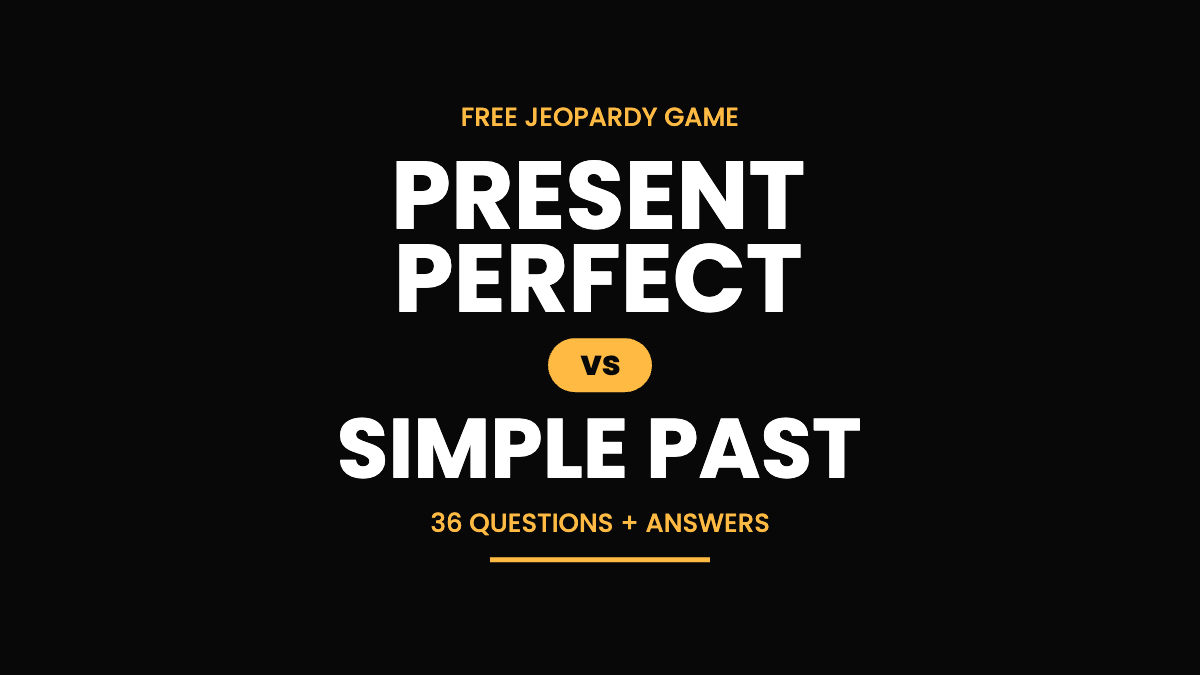
These present perfect vs simple past exercises intermediate level turn the whole lesson into a free Jeopardy game with 36 questions: already or yet, present perfect questions, just and yet, finished time, ago, last and when, and results in the present. Need to review first? Read our Past Perfect Tense lesson, then practise the verb forms with our irregular verbs exercises and the irregular verbs list.
Table of Contents
Present Perfect vs Simple Past Exercises Intermediate Level: Play the Jeopardy Game
How many teams are playing?
Choose 1 to 6 teams. You can play alone, in pairs of teams, or with the whole class.
- Pick a tile: the bigger the number, the harder the question.
- You have 20 seconds. The timer is separate from the Reveal answer button.
- Right answer: the team wins the points. Wrong answer: that team is out and the next team can try.
Answer Key: Present Perfect vs Simple Past Jeopardy Questions
Category 1
-
100 points: The plane has ___ left.
- already
- yet
- ever
- ago
Answer: A. Already goes between has/have and the past participle: The plane has already left.
-
200 points: They have ___ sent the letter.
- yet
- already
- ago
- ever
Answer: B. The letter is sent, and sooner than expected: already, placed after have.
-
300 points: He hasn’t called us ___.
- already
- yet
- just
- ago
Answer: B. In negative sentences we use yet at the end: it has not happened, but we expect it to.
-
400 points: John has ___ bought the tickets for the football match.
- already
- yet
- ago
- last
Answer: A. In a positive sentence about something that is done, we use already.
-
500 points: You haven’t visited Tokyo ___.
- already
- ago
- last year
- yet
Answer: D. A negative present perfect sentence takes yet at the end: You haven’t visited Tokyo yet.
-
600 points: We have ___ been to Mexico three times.
- yet
- already
- ago
- last
Answer: B. The trips are done and the number is a surprise (three times is a lot), so we use already.
Category 2
-
100 points: ___ you ever ___ in a TV studio?
- Have / been
- Did / been
- Have / be
- Are / been
Answer: A. Ever asks about experience up to now: Have + subject + past participle (been).
-
200 points: ___ Tim ___ his work yet?
- Did / finished
- Has / finished
- Has / finish
- Does / finished
Answer: B. Yet in a question goes with the present perfect: Has + subject + past participle.
-
300 points: The car looks clean. ___ you ___ it?
- Did / wash
- Have / washed
- Have / wash
- Do / washed
Answer: B. We see a result now (the clean car), so we ask with the present perfect: Have you washed it?
-
400 points: Has John bought a new car ___?
- yet
- ago
- last week
- yesterday
Answer: A. In questions about something we expect to be done, we use yet at the end. (Already can also appear in a question to show surprise.)
-
500 points: Has she done it ___? No, not ___.
- already / yet
- yet / yet
- yet / already
- already / already
Answer: B. The question asks about something expected: yet. The short negative answer is also not yet.
-
600 points: A: Haven’t they arrived ___? B: Oh, yes. They have ___ arrived.
- yet / already
- already / yet
- yet / yet
- already / already
Answer: A. A asks if they have arrived (yet, in a question). B says they have arrived (positive, so already).
Category 3
-
100 points: The train ___ .
- has just arrived
- have just arrived
- has arrived just
- is just arrived
Answer: A. Present perfect: has + just + past participle. Train is singular, so has.
-
200 points: They ___ out.
- just have gone
- have just gone
- have gone just
- are just gone
Answer: B. Just goes between have and the past participle (gone): They have just gone out.
-
300 points: Which words normally go with the PRESENT PERFECT?
- yesterday, ago, last year
- already, yet, just
- in 2019, last week, then
- two days ago, last night, when
Answer: B. Already, yet, just (and ever, never) link the past to now. Yesterday, ago, last year and similar words give a finished time, so they go with the simple past.
-
400 points: ___ you ___ the letters yet?
- Did / sent
- Have / sent
- Have / send
- Has / sent
Answer: B. Yet asks about the present situation: Have + you + past participle (sent).
-
500 points: They ___ the film yet.
- didn’t see
- haven’t seen
- haven’t saw
- hasn’t seen
Answer: B. Not yet goes with the present perfect: haven’t + past participle (seen). They is plural, so haven’t.
-
600 points: Which sentence is correct?
- I have just seen him yesterday.
- He has yet left.
- She hasn’t arrived yet.
- They have already finished yesterday.
Answer: C. Yesterday needs the simple past, so the first and last sentences are wrong. Yet goes at the end of a negative sentence or a question, not before the verb.
Category 4
-
100 points: ___ he ___ it yesterday?
- Has / finished
- Did / finish
- Did / finished
- Does / finish
Answer: B. Yesterday is a finished time, so we use the simple past: Did + subject + base verb.
-
200 points: ___ Ann ___ yesterday afternoon?
- Has / studied
- Did / studied
- Did / study
- Was / study
Answer: C. Yesterday afternoon is finished: Did + Ann + base verb (study).
-
300 points: ___ she ___ him a week ago?
- Did / call
- Has / called
- Did / called
- Does / call
Answer: A. Ago points to a finished time: Did + she + base verb (call).
-
400 points: ___ you and Tom ___ the party last night?
- Have / enjoyed
- Did / enjoy
- Did / enjoyed
- Do / enjoy
Answer: B. Last night is finished: Did + subject + base verb (enjoy).
-
500 points: ___ you ___ school last year?
- Haven’t / finished
- Didn’t / finished
- Didn’t / finish
- Don’t / finish
Answer: C. Last year is a finished time: Didn’t + subject + base verb. After didn’t, the verb stays in the base form.
-
600 points: Why ___ to play tennis last Friday?
- hasn’t Jim wanted
- didn’t Jim want
- Jim didn’t want
- didn’t Jim wanted
Answer: B. Last Friday is finished: Wh-word + didn’t + subject + base verb. A question needs inversion.
Category 5
-
100 points: They ___ out a minute ago.
- have gone
- went
- has gone
- have went
Answer: B. A minute ago gives a finished time, so we use the simple past: went.
-
200 points: Jane ___ her car two weeks ago.
- has bought
- bought
- buys
- have bought
Answer: B. Two weeks ago is a finished time: simple past (bought).
-
300 points: Which time word can we use with the SIMPLE PAST?
- ago
- ever
- already
- yet
Answer: A. Ago gives a definite finished time (two years ago). Ever, already and yet are used with the present perfect.
-
400 points: When we were on holiday, the weather ___ terrible.
- has been
- is
- was
- were
Answer: C. The holiday is finished, so we use the simple past. Weather is singular: was.
-
500 points: When ___ smoking?
- has he given up
- did he give up
- he gave up
- did he gave up
Answer: B. A question with When asks about a finished moment: When + did + subject + base verb.
-
600 points: Which sentence is correct?
- When I was a child, I have lived in Rabat.
- When I was a child, I lived in Rabat.
- When I was a child, I live in Rabat.
- When I have been a child, I lived in Rabat.
Answer: B. When I was a child names a finished period, so both verbs are in the simple past.
Category 6
-
100 points: I ___ my dictionary. I can’t find it anywhere.
- lost
- have lost
- was losing
- lose
Answer: B. A past action with a result now (I still can’t find it) takes the present perfect: have lost.
-
200 points: We use the present perfect to talk about a past action that …
- has a result or a link with now
- finished at a definite time in the past
- will happen tomorrow
- happened before another past action
Answer: A. The present perfect links the past to the present. A definite finished time needs the simple past; an action before another past action needs the past perfect.
-
300 points: His hair looks short. He ___ a haircut.
- had
- has had
- has have
- is having
Answer: B. We see the result now (short hair), so we use the present perfect: has had.
-
400 points: My bicycle isn’t here. Somebody ___ it.
- took
- has taken
- has took
- was taking
Answer: B. The result is in the present (the bicycle is missing): has taken. Taken is the past participle of take.
-
500 points: Which sentence tells us that Sam is STILL in Paris?
- Sam has gone to Paris.
- Sam went to Paris.
- Sam has been to Paris.
- Sam was in Paris.
Answer: A. Has gone means he went there and has not come back. Has been means he went and came back.
-
600 points: I ___ my keys yesterday, but I found them this morning.
- have lost
- lost
- lose
- am losing
Answer: B. Yesterday is a finished time and the problem is solved, so we use the simple past.
What Are Present Perfect vs Simple Past Exercises Intermediate Level?
Quick answer: present perfect vs simple past exercises train you to choose between have/has + past participle and the simple past. We use the present perfect when a past action is connected to now, and the simple past when the action belongs to a finished time. This page gives you 36 free questions in a Jeopardy game, with the correct answer and a short explanation for every question.
The questions come from two classic exercises: filling the gaps with already or yet, and putting verbs in the simple past or the present perfect. We added a few extra questions on time words and on results in the present, so the game covers the whole difference between the two tenses.
How to Play the Present Perfect vs Simple Past Exercises Intermediate Level Game
- Choose 1 to 6 teams. You can play alone, with 2 teams or with the whole class.
- Teams take turns to pick a tile. The bigger the number, the harder the question.
- Pick one answer within 20 seconds. The timer runs on its own and has Pause and Restart buttons.
- A right answer wins the points. A wrong answer puts that team out, and the next team can try.
- Use Reveal answer to see the correct answer without points, and the Full screen button to play on a projector.
Present Perfect: Form and Use
How to Form the Present Perfect
The present perfect is formed with have or has + past participle. The negative adds not (haven’t, hasn’t), and questions put have or has before the subject.
- Affirmative: They have sent the letter.
- Negative: He hasn’t called us yet.
- Question: Has John bought a new car yet?
- Short answer: Has she done it yet? No, not yet.
Regular verbs add -ed (washed, finished). Irregular verbs have their own participle: lose becomes lost, take becomes taken, go becomes gone, be becomes been. If you hesitate, check the irregular verbs list.
When to Use the Present Perfect
The present perfect links the past to the present. We use it in three main situations:
- Result now: I have lost my dictionary. I can’t find it anywhere.
- Experience up to now: Have you ever been in a TV studio?
- Recent news with just, already and yet: The train has just arrived.
For a clear explanation of these uses, see the present perfect guide on British Council LearnEnglish.
Simple Past: Form and Use
The simple past is formed with the past form of the verb (worked, bought, went). Negatives and questions use did with the base verb: Did you enjoy the party? She didn’t call him.
We use the simple past for an action that is finished, usually with a time that is finished: yesterday, last night, a week ago, two weeks ago, last Friday, in 2019, when we were on holiday. The time can also be understood from the situation.
- They went out a minute ago.
- Jane bought her car two weeks ago.
- When we were on holiday, the weather was terrible.
- When did he give up smoking?
Present Perfect vs Simple Past: The Key Difference
The best way to choose is to ask one question: is the time finished and named? If the sentence has a finished time word, use the simple past. If it has no time word and we care about the result or the experience now, use the present perfect.
- I lost my keys yesterday, but I found them this morning. (finished time, problem solved)
- I have lost my keys. I can’t open the door. (the problem is still here)
- Did you finish it yesterday? (simple past) / Have you finished it yet? (present perfect)
Compare Sam has gone to Paris (he is still there) with Sam has been to Paris (he went and came back). Both are present perfect, because the sentence is about the present situation, not about a date.
Already, Yet and Just in Present Perfect vs Simple Past Exercises Intermediate Level
These three words are the most common signals of the present perfect. The just, yet, still and already page on British Council LearnEnglish explains them in detail.
- Already goes between have/has and the participle, and shows something is done, often sooner than expected: The plane has already left.
- Yet goes at the end of negatives and questions, and shows we expect something: You haven’t visited Tokyo yet. Has John bought a new car yet?
- Just goes between have/has and the participle and means a short time ago: They have just gone out.
In American English people often use the simple past with these words (Did you do your homework yet?). In British English, and in most school exercises, the present perfect is the expected answer.
Time Expressions: Which Tense Goes With Which Word?
- Present perfect: already, yet, just, ever, never, so far, recently, today, this week.
- Simple past: yesterday, last night, last week, last year, ago, in 2019, when I was a child, when we were on holiday.
Notice that ago always needs the simple past: They went out a minute ago, never They have gone out a minute ago.
Common Mistakes in Present Perfect vs Simple Past Exercises Intermediate Level
Using the Present Perfect With a Finished Time
Wrong: I have seen her last week. Right: I saw her last week. As soon as you see yesterday, last, ago or when we were, switch to the simple past.
Using the Wrong Form After Did or Have
After did, use the base verb: Did you enjoy the party? (not Did you enjoyed). After have or has, use the past participle: Have you sent the letters? (not Have you send).
Forgetting Yet and Already in Questions and Negatives
Yet belongs at the end of a negative sentence or a question. Already belongs in a positive sentence. Mixing them is the most frequent mistake in the first two categories of the game.
How to Get a High Score in the Present Perfect vs Simple Past Exercises Intermediate Level
- Look for a finished time word first: it points straight to the simple past.
- Look for already, yet, just or ever: they point to the present perfect.
- If there is no time word, ask whether the sentence is about a result or an experience now.
- Check the verb form after the auxiliary: base verb after did, past participle after have or has.
- Use the explanation after every question to learn from your mistakes, then play again.
FAQ: Present Perfect vs Simple Past Exercises Intermediate Level
What is the difference between the present perfect and the simple past?
The simple past is for finished actions with a finished time, for example I saw her yesterday. The present perfect is for past actions that are connected to now, for example I have seen her already.
Can I use the present perfect with yesterday or last week?
No. Yesterday, last week, ago and when we were on holiday name a finished time, so they need the simple past: I saw her last week.
When do we use already and yet?
Use already in positive sentences, between have or has and the past participle. Use yet at the end of negative sentences and questions, for something we expect to happen.
Can I play these present perfect vs simple past exercises intermediate level alone?
Yes. Choose 1 team on the start screen. You can also play with 2 to 6 teams in a class.
Where can I do present perfect vs simple past exercises intermediate level online for free?
On this page. It has 36 questions in a Jeopardy game with a 20-second timer, a Reveal answer button for every question and a full answer key with explanations.
- Past Perfect Tense: the full lesson
- Past Perfect Exercises: 30 Best Free Jeopardy Questions with Answers
- Practice Irregular Verbs Exercises
- Irregular verbs list
- Conditional and Wishes
- Free English Grammar Exercises for Moroccan Students
Level: B1 · See more B1 exercises