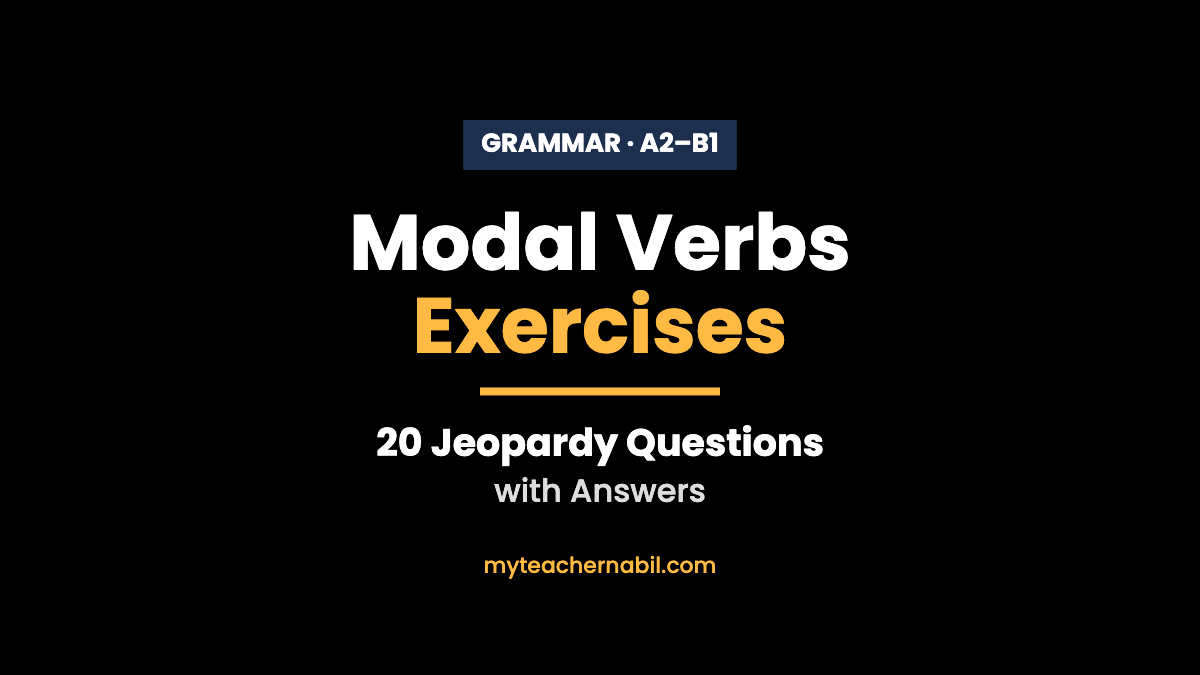
These modal verbs exercises intermediate level turn the main uses of modals into a free Jeopardy game with 20 questions for A2 to B1 learners: ability and permission, obligation and necessity, advice and offers, possibility and deduction in the present, and modal verbs in the past. Need to review first? Read our Modal Verbs 101 lesson, then try our past perfect exercises and the free English grammar exercises for Moroccan students.
Table of Contents
Modal Verbs Exercises Intermediate Level: Play the Jeopardy Game
How many teams are playing?
Choose 1 to 6 teams. You can play alone, in pairs of teams, or with the whole class.
- Pick a tile: the bigger the number, the harder the question.
- You have 20 seconds. The timer is separate from the Reveal answer button.
- Right answer: the team wins the points. Wrong answer: that team is out and the next team can try.
Answer Key: Modal Verbs Jeopardy Questions
Category 1: Ability & Permission
-
100 points: My little sister is only five, but she ___ read short stories.
- can
- cans
- can to
- could to
Answer: A. Present ability: can + base verb. A modal never takes -s and is never followed by to.
-
200 points: When I was ten, I ___ swim very well. I won a medal at school.
- could
- can
- may
- must
Answer: A. Past ability: could + base verb. Could is the past of can.
-
300 points: Which sentence is the MOST formal way to ask for permission?
- Can I use your pen?
- Do I use your pen?
- Will I use your pen?
- May I use your pen?
Answer: D. May I + base verb…? is the most formal and polite way to ask for permission. Can I…? is informal.
-
400 points: The fire was big, but the firemen ___ save everyone in the building.
- can
- might
- could
- were able to
Answer: D. For one specific success in the past we use was/were able to (or managed to), not could.
Category 2: Obligation & Necessity
-
100 points: Our school has rules: all students ___ wear a uniform.
- mustn’t
- might
- must
- needn’t
Answer: C. Obligation: must + base verb (have to is also possible).
-
200 points: You ___ smoke in the hospital. It is forbidden.
- couldn’t
- mustn’t
- needn’t
- don’t have to
Answer: B. Prohibition: mustn’t + base verb = it is not allowed.
-
300 points: Tomorrow is a holiday, so we ___ get up early.
- don’t have to
- mustn’t
- can’t
- shouldn’t
Answer: A. No obligation: don’t have to (or needn’t) = it is not necessary. Mustn’t means it is forbidden.
-
400 points: What is the past of “I must finish my homework”?
- I must finished my homework.
- I must to finish my homework.
- I had to finish my homework.
- I musted finish my homework.
Answer: C. Must has no past form. For obligation in the past we use had to + base verb.
Category 3: Advice, Offers & Requests
-
100 points: You have a bad cough. You ___ see a doctor.
- shall
- would
- may
- should
Answer: D. Advice: should + base verb.
-
200 points: It’s late. We ___ go home now, or we’ll miss the last bus.
- had to better
- would better
- have better
- had better
Answer: D. Strong advice or warning: had better + base verb. “Would better” does not exist.
-
300 points: Those bags look heavy. ___ I help you?
- Shall
- Must
- Should
- Ought
Answer: A. Offer: Shall I + base verb…? (also Shall we…? for suggestions).
-
400 points: Which sentence is correct?
- You oughts to study more.
- You ought study more.
- You ought studying more.
- You ought to study more.
Answer: D. Ought is the only modal followed by to: ought to + base verb. It means the same as should.
Category 4: Possibility & Deduction (Present)
-
100 points: Take an umbrella. It ___ rain later.
- shall
- might
- must
- mustn’t
Answer: B. Possibility (we are not sure): might / may / could + base verb.
-
200 points: Ahmed has been working for ten hours. He ___ be very tired.
- needn’t
- shall
- must
- can’t
Answer: C. Deduction, we are almost sure it is true: must + be.
-
300 points: That ___ be Sara at the door. She is in Paris this week.
- can’t
- must
- may
- should
Answer: A. Deduction, we are sure it is NOT true: can’t + be. We don’t use mustn’t for this.
-
400 points: “He may be at home now.” What does this sentence mean?
- He has to stay at home.
- It is certain that he is at home.
- Perhaps he is at home.
- He is not allowed to be at home.
Answer: C. May + base verb here expresses possibility: perhaps, maybe.
Category 5: Modals in the Past
-
100 points: Which structure do we use with modals to talk about the past?
- modal + have + past participle
- modal + had + base verb
- modal + base verb
- modal + to + base verb
Answer: A. Modal + have + past participle: must have gone, should have studied, can’t have seen…
-
200 points: The streets are wet. It ___ rained last night.
- should have
- needn’t have
- can’t have
- must have
Answer: D. Deduction about the past, almost sure it is true: must have + past participle.
-
300 points: I failed the test. I ___ studied harder.
- might
- must have
- should have
- can’t have
Answer: C. Regret or criticism about the past: should have + past participle (it was a good idea, but I didn’t do it).
-
400 points: She ___ seen me at the market yesterday. I was in Rabat all day.
- can’t have
- would have
- should have
- must have
Answer: A. Deduction about the past, sure it is NOT true: can’t have + past participle.
What Are Modal Verbs Exercises Intermediate Level?
Quick answer: modal verbs exercises practise the small verbs that change the meaning of the main verb: can, could, may, might, must, shall, should, will, would and ought to, together with semi-modals such as have to, need to and had better. A modal tells us how the speaker sees an action: possible, necessary, forbidden, advisable or certain.
The 20 questions in this game check two things at the same time. First, the function: which modal expresses ability, permission, obligation, advice, possibility or deduction. Second, the structure: modal + base verb for the present and the future, and modal + have + past participle for the past.
How to Play the Modal Verbs Exercises Intermediate Level Game
- Choose 1 to 6 teams. You can play alone, with 2 teams or with the whole class.
- Teams take turns to pick a tile. The categories are hidden, and the bigger the number, the harder the question.
- Pick one answer within 20 seconds. The timer has Pause and Restart buttons.
- A right answer wins the points. A wrong answer puts that team out, and the next team can choose another answer.
- The Reveal answer button shows the correct answer and a short explanation, with no points. It is separate from the timer.
- A tile disappears after its question is closed. Use the -100 button to give a penalty and the Full screen button to play on a projector.
Modal Verbs Structure: 5 Rules to Remember
Most mistakes in modal verbs exercises are mistakes of form, not of meaning. Learn these five rules and you will avoid most of them.
- Modal + base verb. The verb after a modal has no to, no -ing and no -ed: She can swim. You should rest. (Not: She can to swim.)
- No -s with he, she and it. Modals have one form for every subject: He must go. It might rain. (Not: He musts go.)
- No do, does or did. Make questions by putting the modal first, and negatives by adding not: Can you help me? You shouldn’t shout.
- Ought to and have to keep to. They are the exceptions: You ought to study. We have to leave.
- For the past, use modal + have + past participle. He must have missed the bus. I should have studied harder.
Negative Forms and Short Forms
| Modal | Negative | Short form |
|---|---|---|
| can | cannot | can’t |
| could | could not | couldn’t |
| may | may not | (no short form) |
| might | might not | mightn’t (rare) |
| must | must not | mustn’t |
| should | should not | shouldn’t |
| will | will not | won’t |
| would | would not | wouldn’t |
| need (modal) | need not | needn’t |
Functions of Modal Verbs in the Present
In the present and the future, every modal is followed by the base verb. What changes is the function, the job the modal does in the sentence. Here are the functions you need for the modal verbs exercises above, with clear examples.
Ability: can
We use can to say that someone is able to do something now. The negative is can’t. For other tenses we use be able to: I will be able to drive next year.
- John can speak English, but he can’t speak Spanish.
- My little sister can read short stories.
Permission: can, could, may
To ask for permission, can is informal, could is more polite and may is the most formal. To give or refuse permission we say you can, you may or you can’t.
- Can I go out, please?
- May I open the window, please?
- You can use my dictionary.
Requests, Offers and Suggestions: could, would, will, shall
Could you…? and Would you…? make polite requests. Would you like…? makes a polite offer. Shall I…? offers help and Shall we…? makes a suggestion.
- Could you bring me a cup of tea, please?
- Would you mind closing the door?
- Shall I carry your bag?
- Shall we go to the cinema?
Obligation and Necessity: must, have to
Must often shows an obligation that comes from the speaker, a rule or a strong feeling. Have to often shows an obligation that comes from outside: a job, a law or a timetable. In many sentences both are correct.
- You must do your homework.
- My sister is a nurse, so she has to work at night.
- All passengers must wear a seatbelt.
Prohibition and No Obligation: mustn’t, don’t have to, needn’t
This is the most important difference in modal verbs exercises. Mustn’t means it is forbidden. Don’t have to and needn’t mean it is not necessary, you are free to choose.
- You mustn’t cross the road when the light is red. (It is forbidden.)
- Tomorrow is a holiday, so we don’t have to get up early. (It is not necessary.)
- You needn’t run. It’s still early.
Advice: should, ought to, had better
Should and ought to give advice or say what is right. Had better is stronger: it gives advice with a warning about a bad result. Its form is had better + base verb; the form “would better” does not exist.
- You should eat more vegetables.
- You ought to study more.
- It’s late. We had better go home, or we will miss the bus.
Possibility: may, might, could
May, might and could say that something is possible, but we are not sure. They mean perhaps or maybe.
- Take an umbrella. It might rain later.
- The driver may be in the car.
- Susan may not come tomorrow.
Deduction: must, can’t
When we are almost sure that something is true, we use must. When we are almost sure that something is not true, we use can’t, not mustn’t.
- He has a great car. He must earn a lot of money.
- That can’t be Sara at the door. She is in Paris this week.
Functions of Modal Verbs in the Past
Talking about the past is where learners hesitate most. Some functions have a simple past form (could, had to). Others use the structure modal + have + past participle.
Past Ability: could, was able to
Could describes a general ability in the past. For one specific success on one occasion we use was/were able to or managed to. In the negative, couldn’t is fine for both.
- My mother could swim very well when she was younger.
- The fire was big, but the firemen were able to save everyone.
- I couldn’t open the door.
Past Obligation: had to, didn’t have to
Must has no past form, so for an obligation in the past we use had to. For no obligation in the past we use didn’t have to.
- The bus didn’t come, so I had to walk to school.
- It was Sunday, so we didn’t have to get up early.
Past Deduction: must have, can’t have
To say that we are almost sure about something in the past, we use must have + past participle. To say that it is impossible, we use can’t have or couldn’t have + past participle.
- The streets are wet. It must have rained last night.
- Tom is late. He must have missed the bus again.
- He can’t have committed the crime: he was with me at that time.
Past Possibility: may have, might have, could have
When something possibly happened in the past but we are not sure, we use may have, might have or could have + past participle.
- I can’t find my keys. I might have left them at school.
- Tom is late. He may have missed the bus.
Regret and Criticism: should have, ought to have
Should have and ought to have + past participle say that something was a good idea, but it did not happen. We use them for regret and criticism. Shouldn’t have says that something happened, but it was a bad idea.
- I failed the test. I should have studied harder.
- You shouldn’t have shouted at your brother.
Unnecessary Actions: needn’t have, didn’t need to
Needn’t have + past participle means you did something, but it was not necessary. Didn’t need to + base verb usually means it was not necessary, so you did not do it.
- You needn’t have bought bread. We already had some.
- I didn’t need to take a taxi, because my friend drove me home.
Modal Verbs in the Present and the Past: Summary Table
Use this table to revise before you play the modal verbs exercises again.
| Function | Present | Past |
|---|---|---|
| Ability | can / be able to | could / was able to |
| Permission | can / could / may | could / was allowed to |
| Obligation | must / have to | had to |
| No obligation | don’t have to / needn’t | didn’t have to / didn’t need to |
| Prohibition | mustn’t / can’t | couldn’t / wasn’t allowed to |
| Advice | should / ought to / had better | should have + past participle |
| Possibility | may / might / could | may / might / could have + past participle |
| Deduction (sure: yes) | must | must have + past participle |
| Deduction (sure: no) | can’t | can’t / couldn’t have + past participle |
Common Mistakes in Modal Verbs Exercises Intermediate Level
He cans swim.→ He can swim. (No -s.)You must to go.→ You must go. (No to after must.)Do you can help me?→ Can you help me? (No do.)You would better leave.→ You had better leave.Yesterday I musted work.→ Yesterday I had to work.You mustn’t come tomorrow, it’s a holiday.→ You don’t have to come. (Not necessary, not forbidden.)That mustn’t be Sara.→ That can’t be Sara. (Negative deduction.)I should studied.→ I should have studied. (Modal + have + past participle.)
Tips for Modal Verbs Exercises Intermediate Level
- Read the whole sentence first. The context tells you the function: a rule (must), a choice (don’t have to), a guess (might) or a regret (should have).
- Look for time words. Yesterday, last night or when I was young tell you that you need a past form.
- Ask: how sure is the speaker? Must = almost sure it is true, might = not sure, can’t = almost sure it is not true.
- Check the verb after the modal. Base verb for the present, have + past participle for the past.
- Learn mustn’t and don’t have to as a pair. Many exam questions test exactly this difference.
- Make your own examples. Write one true sentence about your life for each function in the summary table.
For more grammar practice and clear explanations, visit the British Council LearnEnglish grammar pages.
Frequently Asked Questions
What are the main modal verbs in English?
The main modal verbs are can, could, may, might, must, shall, should, will, would and ought to. Have to, need to and had better work like modals and are often studied with them.
What is the structure of modal verbs?
In the present and the future it is modal + base verb (She can swim). In the past it is modal + have + past participle (He must have missed the bus).
What is the difference between mustn’t and don’t have to?
Mustn’t means it is forbidden: You mustn’t smoke here. Don’t have to means it is not necessary: You don’t have to come tomorrow.
What is the past of must?
For obligation, the past of must is had to: I had to work yesterday. For deduction, use must have + past participle: It must have rained.
Can I play these modal verbs exercises intermediate level alone?
Yes. Choose 1 team on the start screen. You can also play with 2 to 6 teams in a class.
- Modal Verbs 101: the full lesson
- Past Perfect Exercises: 30 Jeopardy Questions
- The Reported Speech
- Free English Grammar Exercises for Moroccan Students
- Best 7 Moroccan BAC English Exercises for EFL Learners
Level: B1 · See more B1 exercises