IMPORTANT NOTE: Please AVOID using READING MODE in your phones because it hides the exercises.
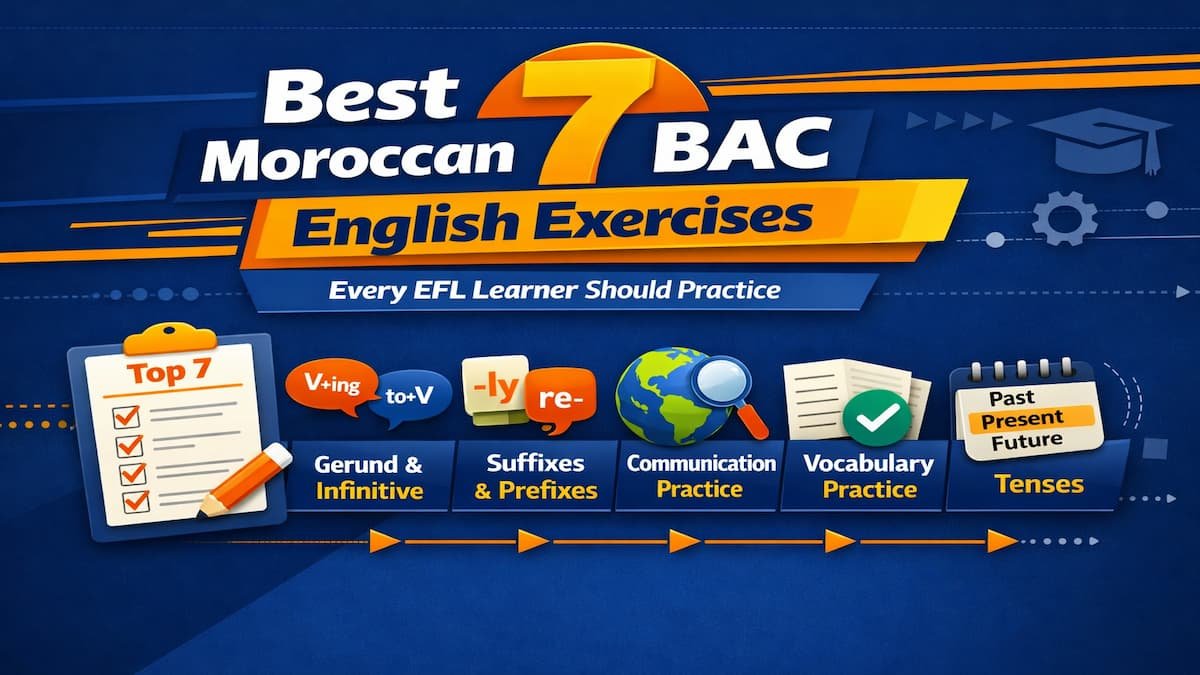
These 7 Moroccan Bac English exercises are meant to help Moroccan students and EFL learners grasp:
- Word formation
- Collocations
- Communication skills
- Tenses
- Gerund & infinitive
- Modal verbs
- Passive voice
Bac English Exercises Morocco: The Complete Guide to Preparing Your Moroccan BAC English Exam
Preparing for the Bac English exercises Morocco requires more than simply reading a textbook. Moroccan students in their second year of the Baccalauréat cycle face a rigorous English exam that tests vocabulary, grammar, reading comprehension, and written expression simultaneously. Whether you are aiming for the literary, scientific, or technical stream, this comprehensive guide will walk you through every major exercise type found in the Moroccan BAC English exercises, explain the underlying grammar rules, and give you the strategies you need to approach each section with confidence.
This article is structured to mirror the actual exam format, covering word formation exercises, gap-fill tasks, situational dialogues, matching functions, gerund and infinitive exercises for the BAC, tense revision, error correction, and sentence transformation. Read it carefully, practice consistently, and you will be far better prepared on exam day.
Why Bac English Exercises Morocco Demand a Structured Approach
The Moroccan Baccalauréat English paper is designed to assess a wide range of competencies within a timed setting. Students who perform best are not necessarily those who have memorised the most vocabulary, but those who understand how the language works systematically. The exam typically includes two major sections: a reading comprehension passage followed by language exercises, and a written expression task. The language exercises section — where Bac English exercises Morocco students lose the most marks — demands precision in grammar, vocabulary, and syntax.
Understanding the structure of each exercise type is the first step. The second is consistent, deliberate practice. Let us begin with the section that trips up the most students: word formation.
Word Formation Exercises: The Core of Moroccan BAC English Exercises
Word formation exercises appear in virtually every Moroccan BAC English paper. The task is deceptively simple: you are given a base word in brackets and must produce the correct derived form to fit the grammatical context of the sentence. In reality, this exercise tests your knowledge of prefixes, suffixes, and the relationship between word classes — nouns, verbs, adjectives, and adverbs.
Understanding Word Formation in English Grammar Exercises
In English grammar exercises at the BAC level, word formation follows predictable patterns. When you see a base word like ambition, you must ask: what word class does the blank require? If the sentence reads “Talented people are often _______ and creative,” you need an adjective to describe people. The adjective derived from ambition is ambitious — formed by adding the suffix -ous.
Similarly, a word like amuse can produce amusing (adjective describing the quality of something), amused (adjective describing someone’s emotional state), or amusement (noun). Context determines which form is required. If the sentence says “The sketch was so _______ that everyone burst out laughing,” the blank modifies the noun “sketch,” so you need an adjective: amusing.
Key Suffixes and Prefixes for Word Formation Exercises
Moroccan BAC students who master the following derivation patterns will handle word formation exercises with ease:
Noun suffixes: -tion / -sion (achieve → achievement / achieve → achievement), -ment (invest → investment), -ity (sustain → sustainability), -ness (cheerful → cheerfulness), -er / -or (teach → teacher).
Adjective suffixes: -ous (ambition → ambitious), -ing (amuse → amusing), -ed (amuse → amused), -al (renew → renewal… but renewable uses -able), -ful (benefit → beneficial uses -ial), -able (renew → renewable), -ive (benefit → beneficial).
Negative prefixes: il- (literacy → illiteracy), im- (moral → immoral), un- (equal → unequal), in- (justice → injustice), ir- (responsible → irresponsible).
Notice how context-sensitive these exercises are. A sentence about NGOs teaching women how to read and write requires the word “illiterate” or refers to “illiterate women” — derived from illiteracy by recognising that the adjective form strips the noun suffix and adds -ate. Precision matters in every Moroccan BAC English exercises paper.
Practical Strategy for Word Formation in the BAC Exam
When approaching word formation exercises, follow these four steps: first, identify the grammatical role of the blank (subject, object, modifier, complement); second, determine the required word class; third, select the appropriate suffix or prefix; fourth, check for spelling changes such as doubling consonants or dropping a final -e. Applying this method consistently across your English grammar exercises practice sessions will make it automatic on exam day.
Fill-in-the-Gap Exercises in Bac English Exercises Morocco
Gap-fill exercises in the Bac English exercises Morocco format come in two varieties: choosing from a thematic word list (often related to the reading passage topic), and completing sentences with fixed expressions or collocations. Both types appear in the standard exam and require different skills.
Thematic Vocabulary Gap-Fill
In this type, a box provides several words — often from topic clusters such as society, education, technology, environment, or youth and citizenship — and you must select the most appropriate one for each blank. Common thematic sets in Moroccan BAC English exercises include:
Social issues: generation gap, social support, local customs, young people, computer technologies.
Personality and emotions: silly, cheerfulness, immune, witty, increase.
Education and empowerment: adult illiteracy, equal opportunity, higher education, rural, empower, resources, access.
For example, a sentence like “Her _______ brightened up the entire room, making everyone feel at ease” requires a noun that fits the subject slot and describes a positive quality radiating from a person. Cheerfulness — the quality of being cheerful — fits perfectly both grammatically and semantically.
Fixed Expression and Collocation Gap-Fill
Some gap-fills test phrasal knowledge: expressions like take place (to happen, occur), take care (to look after), equal opportunity, and higher education are set phrases that Moroccan BAC students must know cold. A sentence like “The teachers’ meeting will _______ in the library at 11 o’clock tomorrow” tests knowledge of the collocation take place, not creative vocabulary use. Building a personal glossary of these fixed expressions is one of the highest-return activities a student preparing for Bac English exercises Morocco can undertake.
Situational Dialogues and Functional Language
One of the most communicative sections of the Moroccan BAC English exercises paper asks students to write appropriate responses to everyday situations. This tests pragmatic competence — the ability to use language correctly in social and communicative contexts. The situations typically require one of the following functions: expressing disagreement, making requests, asking for clarification, expressing surprise, offering help, or giving advice.
Common Communicative Functions in English Grammar Exercises
Moroccan BAC students must have ready-made frames for each communicative function. Here are the most important ones, which recur across years in Bac English exercises Morocco papers:
Expressing disagreement: “I’m afraid I don’t agree with you…” / “I beg to differ…” / “With all due respect, I think…” / “I don’t think that’s entirely accurate because…”
Asking for clarification: “Could you please clarify what you mean by…?” / “Are you saying that…?” / “Do you mean that…?”
Making a request: “Do you mind…?” / “Could you possibly…?” / “Would you be kind enough to…?”
Expressing purpose: “…so that…” / “…in order to…” / “…so as to…”
When a teacher announces “This text is about global warming and climate change,” an appropriate student response might express interest, ask for clarification, or make a relevant observation: “That’s an important topic. Does the text focus on the causes or the consequences of climate change?” This demonstrates engagement and genuine communicative competence.
Matching Functions: Discourse and Pragmatic Awareness in Moroccan BAC English Exercises
The matching-functions exercise in the Bac English exercises Morocco paper presents a series of statements and asks students to identify the communicative or discourse function of each. This is a higher-order skill that requires students to think beyond the literal meaning of a sentence and identify its rhetorical purpose.
Functions Tested in Moroccan BAC English Grammar Exercises
Students preparing English grammar exercises for the BAC should be familiar with the following functional categories:
Cause and effect: sentences using because, due to, as a result of, therefore, consequently. For example: “The wedding party was delayed due to financial problems” expresses cause.
Purpose: sentences using so that, in order to, to + infinitive. For example: “She saved money so that she could buy a new laptop” expresses purpose.
Concession: sentences using despite, although, even though, however. For example: “Many people attended the match despite the bad weather” expresses concession.
Addition: sentences using along with, in addition to, furthermore, moreover.
Asking for clarification: “Are you saying that…?” / “Do you mean that…?”
Mastering these connectors and their functions will not only help you in the matching exercise but also dramatically improve the quality and coherence of your written expression — a skill that pays dividends across all sections of the Moroccan BAC English exercises.
Tenses Exercises: Mastering Time in Moroccan Baccalauréat English
No area of the Bac English exercises Morocco paper is more consistently tested than verb tenses. The tenses exercises Moroccan baccalauréat candidates encounter require accurate use of the present simple, present continuous, past simple, past perfect, future simple, future perfect, and future continuous — often within a single connected paragraph.
The Most Tested Tense Combinations in Bac English Exercises Morocco
The following tense combinations appear most frequently in tenses exercises Moroccan baccalauréat papers and deserve focused revision:
Past Simple and Past Perfect in Sequence
When two past actions are described and one clearly happened before the other, English uses the past perfect for the earlier event and the past simple for the later one. For example: “He started a new book last night after he had finished Voltaire’s Candide.” The finishing of Candide preceded the starting of the new book, so the past perfect is used for the earlier action.
Future Perfect and Future Continuous
The future perfect (will have + past participle) expresses an action that will be completed before a specified future point: “By the end of this month, we will have finished all the rehearsals.” The future continuous (will be + -ing) expresses an action in progress at a future moment. These distinctions are regularly tested in tenses exercises Moroccan baccalauréat assessments.
Present Simple for Scheduled Future Events
When referring to a fixed, scheduled future event — especially a competition, exam, or timetabled occurrence — the present simple is often used: “The reading competition takes place in three months’ time.” This form signals an official schedule rather than a personal intention or prediction.
Present Continuous for Actions in Progress Now
The present continuous describes what is happening at the moment of speaking: “Now he is reading a new book.” Combined with a past simple for when the action started (“He started it last night”), this creates a coherent narrative that demonstrates tense control — a key competency in Bac English exercises Morocco grading rubrics.
Gerund and Infinitive Exercises for the BAC: A Critical Grammar Topic
Among all English grammar exercises tested at the Moroccan BAC level, the gerund versus infinitive distinction causes the most confusion — and consequently the most lost marks. Understanding this area thoroughly is essential for students targeting high scores in Bac English exercises Morocco.
What Are Gerunds and Infinitives?
A gerund is a verb form ending in -ing that functions as a noun: swimming, laughing, completing. An infinitive is the base form of a verb, usually preceded by to: to swim, to laugh, to complete. Both can follow certain verbs, prepositions, and adjectives — but the rules governing which form to use are specific and must be memorised for gerund and infinitive exercises BAC success.
Verbs That Require Gerunds in Gerund and Infinitive Exercises BAC
The following verbs are always followed by a gerund in standard gerund and infinitive exercises BAC items: stop, enjoy, avoid, consider, keep, mind, suggest, recommend, admit, deny.
This is why “Sarah can’t stop laughing at her friend’s silly jokes” is correct — not “stop to laugh,” which would mean stopping in order to laugh (a purpose infinitive with a completely different meaning). Equally, “Students are encouraged to participate in extracurricular activities” uses the infinitive because the verb encourage is followed by an object plus infinitive.
Verbs That Require Infinitives
These verbs take a to-infinitive: want, need, decide, plan, hope, encourage, allow, help, advise.
Critically, some verbs change meaning depending on whether they are followed by a gerund or an infinitive. Regret + gerund refers to a past action the speaker is sorry about: “Mark regrets not completing his university degree” (he wishes he had completed it). Regret + infinitive is used in formal announcements: “We regret to inform you that…”
Gerunds After Prepositions
One rule that is absolute in English: after any preposition, you must use a gerund, never an infinitive. This is why “To promote sustainable development, we need to encourage using renewable energy sources” — after encourage used with a direct object approach, or “we need to encourage the use of” is preferred — the key point is that a preposition must be followed by -ing. For example: “She is interested in learning more about renewable energy.” This rule appears repeatedly in gerund and infinitive exercises BAC correction tasks.
Error Correction Exercises in the Moroccan BAC English Exam
Error correction in Bac English exercises Morocco papers asks students to identify and fix underlined mistakes in sentences. The errors tested fall into predictable categories, which means targeted preparation pays off enormously.
Most Common Error Types in Moroccan BAC English Exercises
The following error types recur most frequently in Moroccan BAC English exercises error-correction tasks:
Gerund vs. infinitive confusion: Using an infinitive where a gerund is required after certain verbs (e.g., “stop to laugh” instead of “stop laughing”), or using a gerund where an infinitive is required (e.g., “encouraged participating” instead of “encouraged to participate”).
Verb complement errors after “help,” “need,” “encourage,” “advise”: These are among the most tested in English grammar exercises at the BAC level. “Formal education helps students develop their critical thinking skills” — help is followed by a bare infinitive (without to) in informal usage, or to + infinitive in formal usage. Either is acceptable; the error version would be “helps students developing.”
Tense errors: Using the wrong tense in a sequence (present perfect instead of past simple when a time marker is present, for example).
Subject-verb agreement errors.
Wrong word form: Using a noun where an adjective is required, or vice versa — which connects directly back to the word formation exercises section.
Sentence Transformation Exercises: Advanced Grammar for Bac English Exercises Morocco
Sentence transformation is the most structurally demanding part of the Bac English exercises Morocco language section. Students are given a sentence and must rewrite it according to a given instruction — using passive voice, modal verbs, purpose clauses, or reported speech — while preserving the original meaning exactly.
Passive Voice Transformations
Passive voice transformations are among the most common in Moroccan BAC English exercises. The rule is: the object of the active sentence becomes the subject of the passive, the verb becomes be + past participle, and the original subject either disappears or appears in a by phrase.
Active: “The Moroccan government has implemented many initiatives to promote sustainable development.”
Passive: “Many initiatives have been implemented by the Moroccan government to promote sustainable development.”
Active: “The computer company launched a new website.”
Passive: “A new website was launched by the computer company.”
Active: “They have invited many African ministers to the conference.”
Passive: “Many African ministers have been invited to the conference.”
Modal Verb Transformations: Deduction with “Must Have”
When a sentence implies a logical deduction about the past, the transformation requires must have + past participle. For example: “Leila speaks perfect English. I’m sure she lived abroad.” Transformed: “She must have lived abroad.” This structure — must have + past participle — expresses near-certainty about a past situation based on present evidence. It is a staple of English grammar exercises in the Moroccan BAC context.
Purpose Clause Transformations
Purpose clauses use so that (followed by subject + modal/verb) or in order to / to (followed by infinitive). The transformation “He told jokes during the meeting. He wanted them to relax and enjoy the atmosphere” becomes: “He told jokes during the meeting so that they could relax and enjoy the atmosphere.” This connector signals purpose and must be mastered for Bac English exercises Morocco sentence rewriting tasks.
Topic Vocabulary for Moroccan BAC English Exercises: Key Themes to Master
The reading passages and vocabulary exercises in Moroccan BAC English exercises consistently draw from a set of recurring themes. Students who build deep vocabulary around these themes will have a major advantage across all sections of the paper.
Theme 1: Education and Youth in Bac English Exercises Morocco
This theme generates vocabulary around: higher education, equal opportunity, adult illiteracy, drop-out rates, extracurricular activities, academic achievement, formal education, critical thinking, and school engagement. Sentences like “Reducing the rates of drop-outs in Morocco will be an important achievement” draw directly from this cluster.
Theme 2: Environment and Sustainable Development
This theme generates: renewable energies, investment, beneficial, sustainable development, resources, environment, climate change, global warming, conservation, and carbon emissions. Morocco’s genuine commitment to renewable energy — including the Noor solar complex in Ouarzazate — makes this a deeply relevant and frequently tested topic in Bac English exercises Morocco papers.
Theme 3: Society, Technology, and Youth Citizenship
This theme includes: generation gap, social support, computer technologies, political engagement, social media, civic responsibility, empowerment, rural communities, and gender equality. Questions about youth participation in political life and the impact of technology on communication are standard fare in Moroccan BAC English exercises.
A Complete Revision Strategy for Bac English Exercises Morocco
Having surveyed all the major exercise types found in Bac English exercises Morocco papers, let us now outline a practical, week-by-week revision plan that Moroccan BAC students can follow in the months leading up to the exam.
Weeks 1–2: Word Formation and Vocabulary
Dedicate the first two weeks exclusively to word formation exercises and thematic vocabulary. Build a suffix/prefix chart. Practice deriving all four word classes (noun, verb, adjective, adverb) from twenty base words per day. Focus on the three major BAC themes outlined above. Test yourself daily using past paper vocabulary sections.
Weeks 3–4: Tenses and Gerund/Infinitive
Weeks three and four target the two most grammar-intensive areas: tenses exercises Moroccan baccalauréat revision, and gerund and infinitive exercises BAC practice. Complete at least one full tense-sequence exercise per day. Memorise the key verb lists for gerunds and infinitives. Practice error correction with a focus specifically on these two areas.
Weeks 5–6: Sentence Transformation and Situational Dialogues
Focus on passive voice, modal deductions, and purpose clauses. Practice writing communicative responses for all major functions. Complete full past paper language sections under timed conditions. Mark your own work against model answers and note recurring errors.
Final Week: Full Past Papers Under Exam Conditions
In the final week before the exam, attempt complete past papers under strict timed conditions. This builds stamina and helps identify any remaining weak points. Focus your last days of revision on those specific areas rather than reviewing material you already know well.
Common Mistakes Moroccan BAC Students Make in English Grammar Exercises
Years of examining Bac English exercises Morocco papers reveal a set of mistakes that appear with striking regularity. Being aware of these pitfalls is itself a form of exam preparation.
Mistake 1: Confusing “Amused” and “Amusing” in Word Formation Exercises
The -ed / -ing adjective distinction is one of the most commonly confused areas in word formation exercises. “-ing” adjectives describe the quality of a thing (the sketch was amusing); “-ed” adjectives describe how a person feels (the audience was amused). Mixing these up costs straightforward marks.
Mistake 2: Using “Gerund” After Certain Adjectives Instead of Infinitive
After adjectives like important, necessary, difficult, easy, happy, glad, the correct form is the infinitive: “It is important to study regularly.” This error frequently appears in gerund and infinitive exercises BAC answer scripts.
Mistake 3: Omitting “Have Been” in Present Perfect Passive
In present perfect passive constructions, both auxiliaries are required: have been + past participle. “Many initiatives have been implemented” — not “Many initiatives have implemented” or “Many initiatives were implemented” (which changes the tense from present perfect to past simple). This is a crucial distinction in English grammar exercises at the BAC level.
Mistake 4: Forgetting the “By” Phrase When It Is Essential
While the “by” phrase in passive constructions is often optional, in sentence transformation tasks it may be required to preserve the full meaning. When instructions say “rewrite beginning with Many initiatives…”, include the agent (by the Moroccan government) to demonstrate full comprehension of the transformation.
Conclusion: Succeeding in Bac English Exercises Morocco with Confidence
The Bac English exercises Morocco paper is demanding but thoroughly predictable in its structure. Every section — word formation exercises, gap-fills, situational dialogues, function matching, tenses exercises Moroccan baccalauréat, gerund and infinitive exercises BAC, error correction, and sentence transformation — follows established patterns that can be mastered through systematic study and consistent practice.
The students who perform best in Moroccan BAC English exercises are not those with the most natural talent but those with the most disciplined preparation. They have built their vocabulary thematically, memorised their verb lists, practised passive voice transformations until they are automatic, and entered the exam room knowing exactly what to expect and how to approach it.
Use this guide as a roadmap. Return to each section regularly. Build your own examples. Practice not just until you get things right, but until you cannot get them wrong. The Moroccan Baccalauréat English exam is one of the most consequential assessments of your academic career — and with the right preparation, it is one you can approach with genuine confidence.
Tags: Bac English exercises Morocco, Moroccan BAC English exercises, English grammar exercises, word formation exercises, gerund infinitive exercises bac, tenses exercises Moroccan baccalauréat, 2BAC English, passive voice exercises, sentence transformation bac, Moroccan baccalauréat English