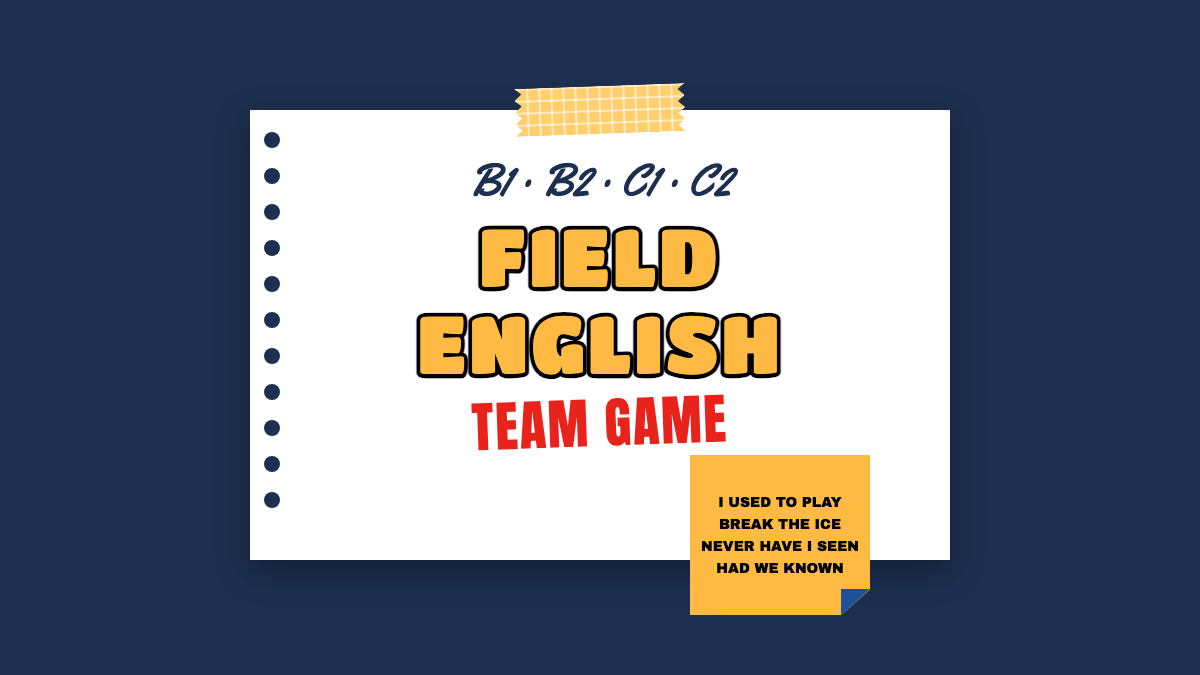
This english team game, Field English, gives you 160 free cards from B1 to C2: grammar, vocabulary, speaking, idioms and style. Teams draw a card, answer it and win a point, or do a quick exercise like push-ups when they get it wrong. For a board game with points, try the Present Simple Jeopardy Game.
Table of Contents
English Team Game: Play Field English Now
Team chooses a category
Settings
Levels in the deck
Penalties for a wrong answer
Card time
Tap a name to rename it. Tap a team to make it their turn.
Forfeit log
Answer Key: All 160 Field English Cards
Level B1
Vocabulary: Name 5 things you can find in a park. 20 seconds!
Answer: e.g. bench, tree, path, fountain, swing Any 5 correct outdoor nouns count.
Grammar: Make a true sentence with ‘used to’ about your childhood.
Answer: I used to + base verb (I used to play marbles.) ‘Used to’ + base verb talks about past habits that are no longer true.
Speaking: Describe your favourite food in 30 seconds without saying its name. Your team guesses.
Answer: Team must guess it in one try. Describing without the word trains paraphrasing: colour, taste, ingredients.
Grammar: Correct the sentence: ‘She don’t like football.’
Answer: She doesn’t like football. With he/she/it, the present simple negative is ‘doesn’t’, not ‘don’t’.
Vocabulary: Give the opposites: cheap, early, noisy, borrow.
Answer: expensive, late, quiet, lend You lend TO someone; you borrow FROM someone.
Grammar: Write the question. The answer is: ‘Since 2019.’
Answer: How long have you lived/studied here? / Since when have you…? ‘Since’ + a starting point needs a ‘How long…?’ question in the present perfect.
Spelling: Spell ‘necessary’ out loud. No paper!
Answer: N-E-C-E-S-S-A-R-Y Tip: one C, two S’s, like a shirt with one collar and two sleeves.
Grammar: Past simple of: buy, think, catch, teach.
Answer: bought, thought, caught, taught These are irregular verbs; they don’t take -ed.
Speaking: Compare football and basketball using 3 comparatives.
Answer: e.g. faster, more popular, easier than… Short adjectives add -er (faster); long ones use ‘more’ (more popular).
Vocabulary: What does ‘give up’ mean? Use it in a sentence.
Answer: to stop trying / quit (I gave up sugar.) A phrasal verb: the meaning changes completely from ‘give’.
Speaking: Give 3 tips for a healthy life using ‘should’.
Answer: You should sleep 8 hours… ‘Should’ + base verb gives advice; never ‘should to’.
Grammar: Fill the gaps: good __ English, interested __ sport, afraid __ dogs.
Answer: at, in, of Adjective + preposition pairs are fixed; learn them as chunks.
Grammar: Present perfect or past simple? ‘I ___ (visit) Rabat last year.’ / ‘I ___ (never / eat) sushi.’
Answer: visited / have never eaten Finished time (last year) → past simple. Life experience, no time → present perfect.
Grammar: Ask a teammate a ‘How often…?’ question. They answer.
Answer: How often do you…? – Twice a week. ‘How often’ asks about frequency: once, twice, every day…
Grammar: Correct it: ‘I am agree with you.’
Answer: I agree with you. ‘Agree’ is a verb, so no ‘am’ before it.
Grammar: ‘Will’ or ‘going to’? ‘Look at those clouds! It ___ rain.’
Answer: is going to rain Use ‘going to’ when you can see evidence now (the clouds).
Grammar: Correct it: ‘He can to swim very well.’
Answer: He can swim very well. Modals (can, must, should) take the base verb without ‘to’.
Grammar: Superlatives: good, bad, far, happy.
Answer: the best, the worst, the farthest / furthest, the happiest Good, bad and far are irregular; ‘happy’ changes y to i + est.
Grammar: Countable or uncountable? water, chair, money, advice, apple, information.
Answer: U, C, U, U, C, U Uncountable nouns have no plural: no ‘advices’ or ‘informations’.
Error hunt: Find the error: ‘There is many students in the yard.’
Answer: There are many students in the yard. ‘Students’ is plural, so use ‘there are’.
Vocabulary: Name 6 sports in 20 seconds.
Answer: football, tennis, swimming, handball… Any 6 real sports count.
Vocabulary: Name 5 parts of the face.
Answer: eye, nose, mouth, cheek, chin, eyebrow… Any 5 correct face words count.
Vocabulary: Name 4 jobs and say where each person works.
Answer: teacher – school, nurse – hospital… Use ‘works in/at’ + place: a nurse works in a hospital.
Vocabulary: Opposites: strong, wide, polite, remember.
Answer: weak, narrow, rude, forget ‘Rude’ and ‘impolite’ both work.
Vocabulary: Name 5 things in a kitchen in 20 seconds.
Answer: fridge, oven, plate, knife, sink… Any 5 kitchen objects count.
Vocabulary: Name 5 weather words and use one in a sentence.
Answer: sunny, windy, cloudy, rainy, foggy… Many weather adjectives are noun + y: sun → sunny, wind → windy.
Spelling: Spell ‘beautiful’ out loud.
Answer: B-E-A-U-T-I-F-U-L Remember the ‘eau’ in the middle: b-EAU-tiful.
Spelling: Spell ‘Wednesday’ out loud.
Answer: W-E-D-N-E-S-D-A-Y The first D is silent: we say ‘Wenz-day’.
Word formation: Add -ful and -less: care, help, hope, use.
Answer: careful/careless, helpful/helpless, hopeful/hopeless, useful/useless -ful means ‘with’, -less means ‘without’.
Speaking: 30 seconds: describe your best friend (looks + personality).
Answer: Use at least 4 adjectives. Mix looks (tall, curly hair) with personality (kind, funny).
Speaking: 30 seconds: talk about last weekend in the past simple.
Answer: Team counts the past verbs. Regular verbs add -ed; irregular ones change (go → went).
Speaking: Give directions from the school gate to our classroom.
Answer: turn left, go straight, next to… Imperatives give directions: turn, go, cross, take.
Speaking: 30 seconds: what will you do after the Bac?
Answer: will / going to / I’d like to… ‘Going to’ for plans already decided; ‘will’ for decisions made now.
Speaking: Role-play with a teammate: order food in a café.
Answer: Could I have…? How much is…? ‘Could I have…?’ is more polite than ‘I want…’.
Speaking: Describe the place we are in right now in 5 sentences.
Answer: There is / there are… ‘There is’ + singular, ‘there are’ + plural.
Debate: 30 seconds each: ‘Summer is better than winter.’
Answer: Class votes. Give a reason for each point: because, so, also.
Idioms: What does ‘a piece of cake’ mean? Use it.
Answer: very easy An idiom: nothing to do with cake; it means very easy.
Idioms: What does ‘under the weather’ mean?
Answer: feeling a little ill An idiom: slightly sick, nothing to do with the weather.
Register: Make it polite: ‘Give me your pen.’
Answer: Could you lend me your pen, please? ‘Could you…, please?’ sounds polite; an order sounds rude.
Idioms: What does ‘hit the books’ mean?
Answer: to study hard An idiom: ‘hit’ here means start doing something with energy.
Level B2
Grammar: Finish it: ‘If I had more free time, …’
Answer: Second conditional: …I would + base verb. Second conditional: if + past simple, would + verb, for imaginary situations.
Grammar: Make it passive: ‘People speak English all over the world.’
Answer: English is spoken all over the world. Passive = be + past participle, when the doer isn’t important.
Grammar: Report it: He said, ‘I will call you tomorrow.’
Answer: He said (that) he would call me the next/following day. Reported speech moves tenses back (will → would) and changes time words (tomorrow → the next day).
Vocabulary: Make or do? __ homework, __ a mistake, __ an effort, __ the dishes.
Answer: do, make, make, do ‘Do’ for tasks and jobs; ‘make’ for creating or producing something.
Vocabulary: Explain and use: look after, look up, look forward to.
Answer: take care of / search for info / be excited about (+ -ing) ‘Look forward to’ is followed by -ing: I look forward to seeing you.
Debate: 1 minute: ‘Social media does more harm than good.’ The other team argues against.
Answer: Class votes the stronger side. A strong argument = claim + reason + example.
Word formation: Nouns from: decide, improve, succeed, responsible.
Answer: decision, improvement, success, responsibility Noun suffixes: -sion, -ment, -ity. ‘Succeed → success’ is irregular.
Grammar: Join with ‘although’: It was raining. We played the match.
Answer: Although it was raining, we played the match. ‘Although’ joins two contrasting ideas; don’t add ‘but’ too.
Idioms: What does ‘break the ice’ mean? Give an example.
Answer: to make people feel relaxed when they first meet Ice = coldness between strangers; breaking it makes things warmer.
Grammar: Combine: ‘That’s the coach. He trained me.’
Answer: That’s the coach who trained me. Use ‘who’ for people, ‘which’ for things.
Speaking: 45 seconds: persuade the class to try a sport they have never played.
Answer: Use at least two persuasive phrases. Persuasive phrases: You’ll love it because… Why not try…?
Grammar: Correct it: ‘If I would have studied, I would pass.’
Answer: If I had studied, I would have passed. No ‘would’ in the if-clause. Third conditional: if + had done, would have done.
Grammar: Gerund or infinitive? I enjoy ___ (run). I decided ___ (join) the team. I avoid ___ (eat) late.
Answer: running, to join, eating Enjoy and avoid take -ing; decide takes ‘to’ + verb.
Grammar: Finish it: ‘When I arrived at the stadium, the match ___.’
Answer: had already started (past perfect) Past perfect = an action before another past action.
Grammar: Make it passive: ‘They are building a new gym.’
Answer: A new gym is being built. Present continuous passive: is/are being + past participle.
Grammar: Question tags: ‘You play football, ___?’ ‘She can’t swim, ___?’ ‘They’ve finished, ___?’
Answer: don’t you / can she / haven’t they Positive sentence → negative tag; negative sentence → positive tag.
Grammar: Explain ‘used to’ vs ‘be used to’ with 2 examples.
Answer: past habit vs. accustomed to (+ -ing) ‘Used to’ + verb = past habit; ‘be used to’ + -ing = it’s normal for you.
Grammar: ‘He’s not answering. He ___ be asleep.’ Give two possible modals.
Answer: must / might / could ‘Must’ = almost sure; ‘might/could’ = possible.
Grammar: Report the question: ‘Where do you live?’ she asked.
Answer: She asked where I lived. Reported questions use normal word order: where I lived, not where did I live.
Error hunt: Find 2 errors: ‘I have seen him yesterday and he say hello.’
Answer: I saw him yesterday and he said hello. ‘Yesterday’ is finished time, so past simple, not present perfect.
Vocabulary: Meanings: get over, get along with, get away with.
Answer: recover from / have a good relationship / escape punishment Phrasal verbs with ‘get’ have very different meanings.
Collocations: Make, take or have? ___ a decision, ___ a break, ___ fun, ___ progress.
Answer: make, take/have, have, make Fixed collocations. Careful: ‘make fun of’ means to mock someone.
Word formation: Adjectives from: danger, comfort, create, fame.
Answer: dangerous, comfortable, creative, famous Adjective suffixes: -ous, -able, -ive.
Vocabulary: Explain the difference: ‘fun’ vs ‘funny’.
Answer: fun = enjoyable; funny = makes you laugh ‘Fun’ describes an activity; ‘funny’ makes you laugh.
Vocabulary: 5 personality adjectives: 3 positive, 2 negative.
Answer: generous, reliable, outgoing / lazy, selfish Any correct adjectives count, as long as positive vs negative is clear.
Vocabulary: Synonyms for: big, happy, start, smart.
Answer: huge, cheerful, begin, intelligent Synonyms help you avoid repeating the same word.
Word formation: Opposites with prefixes: honest, agree, possible, understand.
Answer: dishonest, disagree, impossible, misunderstand Dis-, im- and mis- make opposites; im- comes before p and m.
Speaking: 1 minute: describe a person who inspires you and why.
Answer: Give at least 2 reasons. Give reasons with ‘because’ and ‘that’s why’.
Speaking: 45 seconds: a problem in your town + 2 solutions.
Answer: One way to solve this is… Solution phrases: One way to…, We could…, The best solution would be…
Speaking: Role-play: you’re a reporter. Interview a teammate who just won a match.
Answer: At least 4 questions. Ask open questions: How did you feel…? What was the key moment…?
Speaking: 45 seconds: commentate what’s happening around us like a radio presenter.
Answer: Present continuous! Present continuous describes what is happening right now.
Speaking: 45 seconds: ‘The best day of my life.’ Use the past continuous once.
Answer: I was … -ing when… Past continuous sets the scene: I was walking when…
Debate: 1 minute each: ‘Homework should be banned.’
Answer: Class votes. Opinion + reason + example, then answer the other side.
Debate: 1 minute each: ‘Boys and girls should play in mixed teams.’
Answer: Class votes. Opinion phrases: In my view…, I’d argue that…
Idioms: Meanings: ‘once in a blue moon’, ‘cost an arm and a leg’.
Answer: very rarely / very expensive Idioms about frequency and price; not literal.
Idioms: Meanings: ‘hit the nail on the head’, ‘pull someone’s leg’.
Answer: exactly right / to joke with someone ‘Pull someone’s leg’ = tease them; no leg is pulled.
Idioms: Meanings: ‘get cold feet’, ‘the ball is in your court’.
Answer: get nervous and want to stop / it’s your decision now ‘Cold feet’ = losing courage; ‘ball in your court’ comes from tennis.
Register: Make it polite: ‘I want to leave early today.’
Answer: Would it be possible for me to leave early today? ‘Would it be possible…?’ is an indirect, polite request.
Register: Formal email to someone you don’t know: how do you open and close it?
Answer: Dear Sir or Madam … Yours faithfully Name unknown: Dear Sir or Madam → Yours faithfully. Name known: Dear Mr X → Yours sincerely.
Idioms: Meanings: ‘keep an eye on’, ‘in hot water’.
Answer: watch carefully / in trouble ‘Keep an eye on’ = watch; ‘in hot water’ = in trouble.
Level C1
Grammar: Start with ‘Never…’: ‘I have never seen such a big crowd.’
Answer: Never have I seen such a big crowd. A negative adverb at the start → invert: Never have I…
Grammar: Start with ‘What…’: ‘I need a long holiday.’
Answer: What I need is a long holiday. A ‘What…’ cleft sentence puts the focus on the key part.
Idioms: Explain: ‘bite off more than you can chew’, ‘sit on the fence’, ‘a blessing in disguise’.
Answer: take on too much / not decide / something bad that turns out good These idioms describe effort, indecision and luck.
Speaking: Say ‘It’s raining heavily’ in 3 different ways.
Answer: pouring down, bucketing down, raining cats and dogs… Good speakers vary their language instead of repeating words.
Debate: 1 minute: ‘Exams measure memory, not intelligence.’ Other team responds.
Answer: Class votes. Strong debaters also answer the other side’s argument.
Grammar: Finish (mixed conditional): ‘If I had grown up in another country, I … now.’
Answer: …I would speak / would be… (past cause, present result) Mixed conditional: past condition (had grown up) → present result (would speak now).
Word formation: Make these negative: legal, responsible, patient, logical.
Answer: illegal, irresponsible, impatient, illogical il- before l, ir- before r, im- before p, in- elsewhere (mostly).
Register: Make it formal: ‘We need to find out what’s going on.’
Answer: We need to establish / investigate the current situation. Formal English avoids phrasal verbs and contractions: ‘find out’ → ‘establish’.
Register: Soften (hedge) it: ‘This plan will fail.’
Answer: It seems likely that this plan may not succeed. Hedging (seems, may, likely) makes claims careful and academic.
Grammar: Three sentences: ‘I wish’ (present), ‘If only’ (past), ‘I wish… would’ (annoyance).
Answer: I wish I were taller / If only I had trained / I wish he would stop… ‘Wish’ + past = present; ‘if only’ + past perfect = past; ‘wish + would’ = annoying habit.
Speaking: 1 minute: explain the rules of a sport to someone who has never seen it. No hand gestures!
Answer: Hands behind your back. Sequencing words help: First…, Then…, The aim is…
Collocations: One adjective fits all three: ___ rain, ___ smoker, ___ traffic.
Answer: heavy ‘Heavy’ goes with rain, smoker and traffic; ‘strong rain’ sounds wrong.
Grammar: Start with ‘Not only…’: ‘He won the race and broke the record.’
Answer: Not only did he win the race, but he also broke the record. ‘Not only’ at the start → inversion: did he win…, but also…
Grammar: Start with ‘It was…’: ‘Sara scored the winning goal.’
Answer: It was Sara who scored the winning goal. ‘It was… who/that’ emphasises one part of the sentence.
Grammar: Start with ‘Having…’: ‘After he had finished training, he went home.’
Answer: Having finished training, he went home. Having + past participle shows the first of two actions.
Grammar: Explain + example: ‘should have’, ‘needn’t have’, ‘can’t have’.
Answer: regret / did it but it wasn’t necessary / impossible in the past Past modals = modal + have + past participle.
Grammar: Start with ‘Little…’: ‘She didn’t realise how hard it would be.’
Answer: Little did she realise how hard it would be. ‘Little’ at the start means ‘not at all’ and needs inversion.
Grammar: Use ‘would rather’: ‘I’d prefer you not to shout.’
Answer: I’d rather you didn’t shout. ‘Would rather’ + person + past simple, even about now.
Error hunt: Correct it: ‘Hardly I had arrived when it started to rain.’
Answer: Hardly had I arrived when it started to rain. ‘Hardly… when’ needs inversion + past perfect: Hardly had I…
Collocations: Adverb + adjective: ___ aware, ___ different, ___ disappointed.
Answer: fully, completely, bitterly Strong adverb + adjective collocations native speakers use.
Collocations: Which verbs go with: attention, a promise, a rule?
Answer: pay/draw, keep/break, follow/break Pay attention, keep/break a promise, follow/break a rule.
Word formation: Nouns from: anxious, curious, generous, accurate.
Answer: anxiety, curiosity, generosity, accuracy -ety, -ity and -acy often come from adjectives ending in -ous or -ate.
Vocabulary: Explain: ‘economic’ vs ‘economical’, ‘sensible’ vs ‘sensitive’.
Answer: about the economy / saves money; practical / easily hurt Commonly confused pairs: they look alike but mean different things.
Vocabulary: Meanings: put off, put up with, put forward.
Answer: postpone / tolerate / propose Three phrasal verbs with ‘put’, all with different meanings.
Vocabulary: 5 verbs more precise than ‘walk’.
Answer: stroll, march, stride, wander, limp Precise verbs are more vivid than ‘walk slowly’.
Vocabulary: Meanings: come across, come up with, come down with.
Answer: find by chance / think of / start to have an illness ‘Come down with’ is used for illnesses: come down with a cold.
Speaking: 1 minute: is technology making us lonelier? Give one personal example.
Answer: Use at least one hedge. Support opinions with an example and a hedge (I’d say…, It seems…).
Speaking: 1 minute: a skill you’d love to master and your plan to do it.
Answer: First…, then…, eventually… Show a plan: First…, After that…, Eventually…
Speaking: Role-play: convince the head teacher to allow phones at break time.
Answer: The ‘head teacher’ can push back. Persuade with reasons and offer a compromise.
Speaking: 1 minute: a story that ends with ‘and that’s why I never do that again.’
Answer: Narrative tenses. Stories use past simple, past continuous and past perfect.
Speaking: 45 seconds: city vs countryside life, using contrast linkers.
Answer: whereas, while, on the other hand, in contrast ‘Whereas’ and ‘while’ contrast two ideas in one sentence.
Debate: 1 minute each: ‘Footballers are paid too much.’
Answer: Class votes. Use concession: Admittedly…, but…
Debate: 1 minute each: ‘Students should choose their own teachers.’
Answer: Class votes. Back each point with a reason and an example.
Debate: 1 minute each: ‘It’s better to be a big fish in a small pond.’
Answer: Class votes. Is it better to be important in a small place or average in a big one?
Idioms: Meanings: ‘the last straw’, ‘go the extra mile’, ‘call it a day’.
Answer: final problem / do more than expected / stop working From ‘the straw that broke the camel’s back’.
Idioms: Meanings: ‘beat around the bush’, ‘jump on the bandwagon’, ‘in the long run’.
Answer: avoid the point / follow a trend / over a long time ‘Beat around the bush’ = not saying something directly.
Register: Make it formal: ‘Sorry, but we can’t help you right now.’
Answer: We regret that we are unable to assist you at present. Formal words: regret, unable, assist, at present.
Register: Make it informal: ‘I would be grateful if you could inform me at your earliest convenience.’
Answer: Let me know as soon as you can. Informal English uses short words and direct requests.
Register: Hedge it: ‘Young people are lazy.’
Answer: Some young people may tend to be less active. Hedging avoids generalising about whole groups of people.
Idioms: Meanings: ‘steal the show’, ‘by the skin of your teeth’, ‘neck and neck’.
Answer: get all the attention / only just / level in a race Idioms about attention, a narrow escape and a close race.
Level C2
Vocabulary: Explain the difference: ‘continual’ vs ‘continuous’.
Answer: continual = repeated with breaks; continuous = without stopping ‘Continual’ = again and again; ‘continuous’ = never stops.
Idioms: Explain: ‘a chip on your shoulder’, ‘the elephant in the room’, ‘cut corners’.
Answer: resentment / obvious problem nobody mentions / do something badly to save time Idioms about resentment, an avoided topic and doing poor work.
Grammar: Start with ‘Had…’: ‘If we had known, we would have left.’
Answer: Had we known, we would have left. Formal conditional: drop ‘if’ and invert: Had we known…
Debate: 1 minute: ‘Elite sport should be funded by the state.’ Other team responds.
Answer: Class votes. Policy debates need evidence, not just opinion.
Vocabulary: Use ‘affect’ and ‘effect’ correctly, each as a verb AND a noun if you can.
Answer: affect (v) / effect (n); effect (v) = bring about ‘Affect’ is usually the verb, ‘effect’ the noun. ‘Effect change’ = cause change.
Speaking: 45-second team talk before a final, with a rhetorical question and a rule of three.
Answer: Rhetorical question + three-part phrase. Rhetorical question + rule of three (We train, we fight, we win).
Vocabulary: 5 words for ‘tired’, from neutral to strongest.
Answer: tired → weary → drained → exhausted → shattered Order by strength: weary, then drained, then exhausted, then shattered.
Grammar: Complete: ‘The coach insisted that every player ___ (arrive) early.’
Answer: arrive (subjunctive) After insist/suggest/demand, use the base verb (subjunctive): every player arrive.
Speaking: Explain ‘Fortune favours the bold’, then argue against it.
Answer: Two clear positions. Arguing both sides shows control of argument.
Error hunt: Find 2 errors: ‘Despite of the rain, the match was took place.’
Answer: Despite the rain, the match took place. ‘Despite’ takes no ‘of’; ‘take place’ is never passive.
Register: Make it tactful: ‘He’s old and slow.’
Answer: He’s getting on a bit and takes his time. Euphemisms soften direct words: ‘getting on a bit’ instead of ‘old’.
Idioms: Explain ‘damning with faint praise’ and give an example.
Answer: praising so weakly it sounds like criticism: ‘Well, he was on time.’ Praising something trivial suggests there’s nothing better to praise.
Grammar: Start with ‘Were…’: ‘If I were in charge, I’d change the rules.’
Answer: Were I in charge, I’d change the rules. Drop ‘if’ and start with ‘Were’.
Grammar: Start with ‘Should…’: ‘If you need help, call me.’
Answer: Should you need help, call me. ‘Should’ at the start replaces ‘if’ for possible future situations.
Grammar: Start with ‘So…’: ‘The wind was so strong that the match was cancelled.’
Answer: So strong was the wind that the match was cancelled. ‘So + adjective’ at the start needs inversion: So strong was…
Grammar: Start with ‘Only after…’: ‘We understood the rules after the game.’
Answer: Only after the game did we understand the rules. ‘Only after’ at the start inverts the main clause: did we understand.
Grammar: Use ‘It’s high time’: ‘We should leave now.’
Answer: It’s high time we left. ‘It’s high time’ + past simple, even though it means now.
Grammar: Start with ‘Much as…’: ‘Although I like him, I can’t agree.’
Answer: Much as I like him, I can’t agree. ‘Much as’ = although, but more formal.
Error hunt: Find 2 errors: ‘The informations he gave me was very usefull.’
Answer: The information he gave me was very useful. ‘Information’ is uncountable (no -s); ‘useful’ has one L.
Error hunt: Find the error: ‘Neither the coach nor the players was happy.’
Answer: were (the verb agrees with ‘players’) With ‘neither… nor’, the verb agrees with the nearer subject.
Vocabulary: Explain: ‘imply’ vs ‘infer’.
Answer: the speaker implies; the listener infers The speaker hints (implies); the listener concludes (infers).
Vocabulary: Explain: ‘disinterested’ vs ‘uninterested’.
Answer: impartial / not interested ‘Disinterested’ = no personal interest, like a fair referee.
Vocabulary: Explain: ‘complement’ vs ‘compliment’.
Answer: completes something / praise ‘Complement’ = goes well with; ‘compliment’ = nice words.
Collocations: Which verbs? ___ a conclusion, ___ a compromise, ___ suspicion.
Answer: draw/reach, reach/strike, arouse/raise Fixed collocations: draw a conclusion, reach a compromise, arouse suspicion.
Vocabulary: 5 ways to say ‘very good’, from mild to strongest.
Answer: decent → impressive → outstanding → superb → phenomenal Grading words by strength shows a wide vocabulary.
Word formation: From ‘courage’: a verb, an adjective, an opposite verb, a noun.
Answer: encourage, courageous, discourage, encouragement One root, many words: prefixes en-, dis- and suffixes -ous, -ment.
Vocabulary: Explain ‘ambiguous’ vs ‘ambivalent’ with examples.
Answer: unclear meaning / mixed feelings ‘Ambiguous’ is about meaning; ‘ambivalent’ is about feelings.
Speaking: 1 minute: failure teaches more than success.
Answer: Use a concession: Admittedly… Concession (Admittedly…) makes an argument stronger.
Speaking: 1 minute: explain a Moroccan tradition to a foreign visitor, without hesitating.
Answer: Hesitate = forfeit. Fluency counts: explain clearly with no long pauses.
Speaking: Role-play: you’re a lawyer defending a player who got a red card.
Answer: Other team = the referee. Lawyer language: My client…, The evidence shows…
Speaking: 1 minute on ‘silence’ without repeating any noun.
Answer: Team listens for repeats. Forces paraphrasing and synonyms instead of repetition.
Speaking: 45 seconds: describe a colour to someone who has never seen.
Answer: Use the other senses. Describe through other senses: Red feels like heat…
Debate: 1 minute each: ‘Talent matters more than hard work.’
Answer: Class votes. Answer the other side’s strongest point directly.
Debate: 1 minute each: ‘AI will make teachers unnecessary.’
Answer: Class votes. Think about what AI can’t do: motivation, empathy, judgement.
Idioms: Meanings: ‘throw in the towel’, ‘move the goalposts’, ‘a level playing field’.
Answer: give up / change the rules unfairly / a fair situation All three idioms come from sport.
Idioms: Meanings: ‘a double-edged sword’, ‘a storm in a teacup’, ‘burn the midnight oil’.
Answer: good and bad / fuss about nothing / work late at night Double-edged sword = helps and harms; storm in a teacup = big fuss over nothing.
Idioms: Explain ‘play devil’s advocate’, then do it for 30 seconds.
Answer: argue the side you don’t believe in Arguing against your own view builds critical thinking.
Register: Make it diplomatic: ‘Your idea is bad and won’t work.’
Answer: I wonder whether this approach might face some challenges. Diplomatic language: I wonder…, might, challenges.
Register: Turn into a headline (max 6 words): ‘The local team lost badly in the final.’
Answer: e.g. Local Heroes Crushed in Final Headlines drop small words (the, a, was) and use strong verbs.
Idioms: Explain ‘Actions speak louder than words’ and give a real example.
Answer: what you do matters more than what you say What people do shows more than what they say.
What Is the Field English Team Game?
Quick answer: Field English is a free English team game for B1 to C2 learners. A team chooses a category (Grammar, Vocabulary, Speaking, or Idioms & Style), draws a card and has 45 seconds to answer (you can change the card time in Settings). A right answer wins 1 point; a wrong answer means the team does the exercise on the card. The game keeps the scores, the turns and a forfeit log for you.
It works on a phone in the schoolyard or the sports field, and on a big screen in class with the Full screen button.
How to Play the English Team Game
- Open the Scores tab and set the teams: 1 to 10 teams, with names you can change.
- On the Cards tab, the team whose turn it is chooses a category, or presses Surprise me.
- The card shows the task, its level and the exercise for a wrong answer. The card timer (45 seconds unless you change it in Settings) starts at once; tap it to pause or start it again.
- When the team has answered, press Show answer to see a model answer and a short explanation.
- Press Correct +1 or Wrong. The turn then passes to the next team.
- Use the Penalty button on the Scores tab for bad behaviour: −1 point and a random exercise.
- Open Settings to change the card time: 30 seconds, 45 seconds, 1 minute or 2 minutes. A referee whistle blows when the time is up.
What Is in Each Category?
| Category | Cards | What the cards ask |
|---|---|---|
| Grammar | 49 | Tenses, conditionals, passive, reported speech, inversion and error hunts. |
| Vocabulary | 42 | Word lists, opposites, phrasal verbs, spelling, word formation and collocations. |
| Speaking | 40 | Short talks, role-plays and one-minute debates; the class votes. |
| Idioms & Style | 29 | Idioms and register: polite, formal, informal and diplomatic English. |
Which Level Should You Choose?
Each level has 40 cards. Open Settings under the categories to keep only the levels you want in the deck, to choose which exercises (burpees, push-ups, lunges, diamond push-ups) can be a penalty, and to set the card time. For A1 and A2 classes, play the English Team Game for Beginners.
| Level | Good for | Example card |
|---|---|---|
| B1 | Common Core and 1st Bac | Past simple of: buy, think, catch, teach. |
| B2 | 2nd Bac and the national exam | Make it passive: They are building a new gym. |
| C1 | Strong Bac students and university | Start with Not only: He won the race and broke the record. |
| C2 | Advanced learners and teachers | Start with Had: If we had known, we would have left. |
Tips for Teachers Using This English Team Game
- Mix the levels on purpose. Keep B1 and B2 for a normal class, and add C1 for a strong group.
- Let teams choose the category. It makes them think about their strong points, and Surprise me adds risk.
- Use the speaking cards for fluency. Count hesitations or repeated words to decide if the answer is correct.
- Keep the forfeits safe. Use the exercises only on a field or in the gym, and the Penalty button indoors.
- Project the game. Full screen makes the card easy to read from the back of the room.
- For more speaking ideas and topics, see British Council LearnEnglish: Speaking.
Frequently Asked Questions
How many teams can play this English team game?
From 1 to 10 teams. The game starts with 4 teams; open the Scores tab to add a team, remove one or rename them.
What happens when a team gives a wrong answer?
The team gets no point and does the exercise shown on the card, for example 10 push-ups or 5 burpees. The forfeit is written in the forfeit log on the Scores tab.
Who decides if an answer is right?
The teacher or a referee. Press Show answer to see a model answer and a short explanation, then press Correct +1 or Wrong.
Can I play the game without the physical exercises?
Yes. In a classroom you can ignore the exercise on the card and use the Penalty button on the Scores tab, which only takes away 1 point.
Does the timer stop the game?
No. The card timer (45 seconds, or the time you choose in Settings) only blows a whistle. Teams can still answer, and you can still show the answer, after the time is up.
- English Team Game for Beginners (A1 to B2)
- Present Simple Jeopardy Game
- Word Formation Jeopardy Game
- More free English games
- Speaking lessons and activities
- Vocabulary lessons and exercises
Level: B1 to C2 · See more Intermediate exercises