This too and enough lesson takes you from a short text about a polluted river to your own paragraph, in 10 activities with instant answers: find the rule, choose too, enough or very, rewrite sentences and talk about your school and your town. They go well with our sustainable development vocabulary exercises and the verb tenses exercises.
In this exercise page
Too and enough lesson: 10 activities with answers
10 activities with 24 auto-checked questions: find the rule · too or enough · too or very · rewrite · write and speak
Need help? The too / enough rules
- too + adjective / adverb (+ to + base verb): The water is too dirty to swim in. (a negative idea: we can’t)
- adjective / adverb + enough (+ to + base verb): They are strong enough to carry the bags. (a positive idea: we can)
- enough + noun: We have enough volunteers.
- very = a lot, but still possible: The tea is very hot, but I can drink it.
Full lesson with examples: how to use too and enough.
1. Read the text (open answers)
Can people swim in the river today?
Model answer
No, they can't. The water is too dirty to swim in.
Will they swim in it again?
Model answer
Yes, they will. Soon the river will be clean enough to swim in again.
2. Find the rule (4 questions)
Look at the words in bold in the text. Complete the rules.
too + ______ / adverb (+ to + base verb)
adjective / adverb + ______ (+ to + base verb)
______ + noun
too gives a ______ idea. enough gives a ______ idea.
3. Make sentences (4 questions)
the bag / heavy / carry (too)
the city center / noisy / live in (too)
our school / have / bins (enough)
he / run / fast / catch the bus (enough)
Exercise A: Complete with too or enough (6 questions)
The air is ______ polluted to breathe easily.
The beach is ______ dirty for children to play on.
Our school now has ______ recycling bins for every classroom.
It's ______ hot to work outside in the afternoon.
After the clean-up, the beach was clean ______ to walk on.
The new park is big ______ for all the children in the neighborhood.
Exercise B: Rewrite with the word in brackets (4 questions)
not + adjective + enough = too + the opposite adjective.
The river is too polluted. (clean) → The river isn't ______.
The volunteers aren't fast enough. (slow) → The volunteers are ______.
The bin is too small for all this waste. (big) → The bin isn't ______ for all this waste.
Our town isn't green enough. (trees) → Our town doesn't have ______.
Exercise C: Too or very? (6 questions)
The tea is ______ hot, but I can drink it.
The tea is ______ hot to drink.
The mountain is ______ high, but we can climb it.
The box is ______ heavy for me to carry.
Correct the mistakes:
She isn't enough old to vote. →
We have trees enough. →
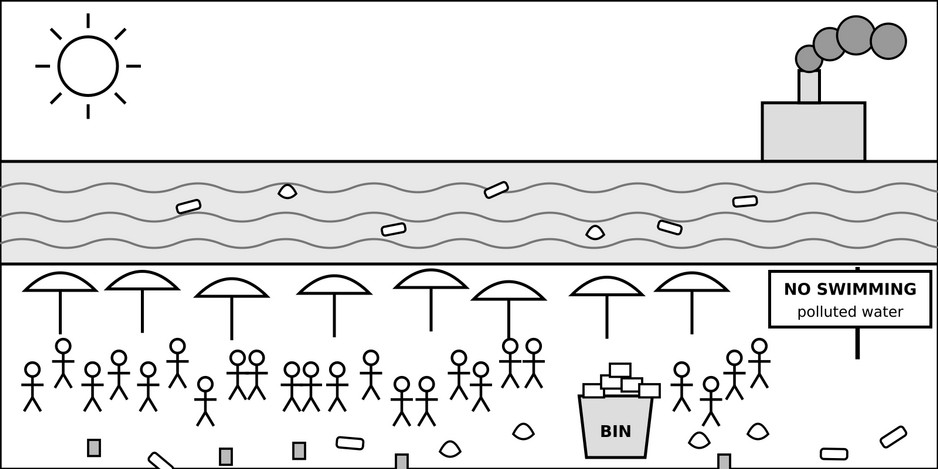
Exercise D: Look at the picture (open answers)
Write three sentences about the picture with too or enough. Then say them to your partner.
Model answer
The beach is too crowded to relax on.
Model answer
There aren't enough bins.
Model answer
The sand is too dirty to sit on.
Exercise E: Write about your school (open answers)
classroom / hot / study
Model answer
The classroom is too hot to study in.
chairs / enough
Model answer
We have enough chairs.
homework / difficult / finish
Model answer
The homework is too difficult to finish.
playground / big enough / play football
Model answer
The playground is big enough to play football.
Task 1: Students' Council meeting (open answers)
Groups of 4: three Students’ Council representatives tell the headmaster about environmental problems at school, using too and enough. The headmaster answers with a suggestion (Why don’t we…? Let’s…). Ideas: classrooms, playground, toilets, garden, bins, trees.
Prepare before you speak:
My complaint 1 (too):
Model answer
The playground is too dirty to play in.
My complaint 2 (enough):
Model answer
We don't have enough recycling bins.
My complaint 3 (too or enough):
Model answer
The classrooms are too hot in June, and there aren't enough trees to give shade.
The headmaster's suggestion:
Model answer
Why don't we plant more trees in the playground? Let's put a bin in every classroom.
Task 2: Write a paragraph (open answers)
What’s wrong with my town’s environment? Write 6–8 sentences. Use at least 5 too / enough structures and underline them. End with one solution.
Sentences: 0 · too / enough: 0
Model paragraph
My town's environment has some serious problems. The streets are too dirty to walk in comfortably, and there aren't enough bins in the city center. The air near the factories is too polluted to breathe easily. Our parks are not big enough for all the families, and there are too many cars on the roads. The buses are too old, so they produce a lot of smoke. One solution is to plant more trees and give people enough buses to leave their cars at home.
Answer Key
1. Read the text
- No, they can't. The water is too dirty to swim in.
- Yes, they will. Soon the river will be clean enough to swim in again.
2. Find the rule
- too + adjective / adverb (+ to + base verb)
- adjective / adverb + enough (+ to + base verb)
- enough + noun
- too gives a negative idea; enough gives a positive idea.
3. Make sentences
- The bag is too heavy to carry.
- The city center is too noisy to live in.
- Our school has enough bins. (also: Our school doesn't have enough bins.)
- He ran fast enough to catch the bus. (also: He runs fast enough to catch the bus.)
Exercise A
- The air is too polluted to breathe easily.
- The beach is too dirty for children to play on.
- Our school now has enough recycling bins for every classroom.
- It's too hot to work outside in the afternoon.
- After the clean-up, the beach was clean enough to walk on.
- The new park is big enough for all the children in the neighborhood.
Exercise B
- The river isn't clean enough.
- The volunteers are too slow.
- The bin isn't big enough for all this waste.
- Our town doesn't have enough trees.
Exercise C
- The tea is very hot, but I can drink it.
- The tea is too hot to drink.
- The mountain is very high, but we can climb it.
- The box is too heavy for me to carry.
- a. She isn't old enough to vote.
- b. We have enough trees.
Exercise D (possible answers)
- The beach is too crowded to relax on.
- There aren't enough bins.
- The sand is too dirty to sit on.
Exercise E (possible answers)
- The classroom is too hot to study in.
- We have enough chairs.
- The homework is too difficult to finish.
- The playground is big enough to play football.
Task 1 (example)
- My complaint 1 (too): The playground is too dirty to play in.
- My complaint 2 (enough): We don't have enough recycling bins.
- My complaint 3 (too or enough): The classrooms are too hot in June, and there aren't enough trees to give shade.
- The headmaster's suggestion: Why don't we plant more trees in the playground? Let's put a bin in every classroom.
Task 2 (model paragraph)
- My town's environment has some serious problems. The streets are too dirty to walk in comfortably, and there aren't enough bins in the city center. The air near the factories is too polluted to breathe easily. Our parks are not big enough for all the families, and there are too many cars on the roads. The buses are too old, so they produce a lot of smoke. One solution is to plant more trees and give people enough buses to leave their cars at home.
Download the student activities, or the teacher’s lesson plan with the answer key.
Tap an activity to open it. Buttons and typed answers are checked at once; the open writing and speaking tasks have a model answer to compare with.
Too and enough lesson plan: teacher’s guide
Lesson information
- Class: 1st Year Baccalaureate
- Structure: too + adjective / adverb (+ to + base verb); adjective / adverb + enough (+ to + base verb); enough + noun
- Time: 45 minutes of teaching (a 55-minute session, minus time for late arrivals and the register)
- Materials: the student activity sheet (with the beach picture for Exercise D), the board.
- Interaction: whole class, individual, pairs, groups of 4
Objectives
By the end of the lesson, students will be able to:
- explain in their own words what too and enough mean and where they go in a sentence (skill level);
- complete and transform sentences with too and enough, getting at least 8 out of 10 right (capability level);
- tell the difference between too and very (capability level);
- describe environmental problems in their town, orally and in a paragraph, using at least 5 too / enough structures correctly (competency level).
Stages at a glance
- Stage 1: Presentation and comprehension check — skill level — 13 min
- Stage 2: Practice in new contexts — capability level — 17 min
- Stage 3: Use and application — competency level — 11 min
- Stage 4: Wrap-up and evaluation — 4 min
Wrap-up, evaluation and homework
Wrap-up (2 min). Write 3 common mistakes from Stage 3 on the board without names (e.g. enough old, too dirty for swim). Students correct them together.
Exit question (2 min). Each student writes one sentence with too and one with enough about today’s weather or the classroom, and hands it in.
Evaluation checklist. The guideline’s checklist: 1 = unsatisfactory, 2 = fairly satisfactory, 3 = satisfactory, 4 = very satisfactory. Score a few students each lesson from Tasks 1 and 2 on automaticity, authenticity, contextualization and skills integration.
Homework (30–40 min at most):
- Finish or correct the paragraph from Task 2.
- Write 5 sentences about your house or neighborhood with too and enough.
- Find two sentences with too or enough in the textbook’s Unit 4 reading text and copy them.
⬇ Download the teacher’s lesson plan (PDF)
Quick answer: how do you use too and enough?
Use too before an adjective or adverb to say something is more than we want, so it is not possible: The water is too dirty to swim in. Use enough after an adjective or adverb, or before a noun, to say we have what we need: strong enough, enough volunteers. Both can take to + base verb. Too gives a negative idea, enough a positive one, and very only means “a lot”.
How to use too and enough: the rules
Every activity in this too and enough lesson uses the same few patterns. Learn them here, then go back and try again the questions you missed.
| Pattern | Meaning | Example |
|---|---|---|
| too + adjective / adverb | more than we want or need | The river is too polluted. |
| too + adjective + to + base verb | so it is not possible | The water is too dirty to swim in. |
| too + adjective + for + person + to + base verb | not possible for this person | The box is too heavy for me to carry. |
| adjective / adverb + enough | as much as we need | The park is big enough. |
| adjective + enough + to + base verb | so it is possible | They are strong enough to carry the bags. |
| enough + noun | the quantity we need | We have enough volunteers. |
| not + adjective + enough | less than we need | The bin isn’t big enough. |
Too + adjective or adverb
Too always comes before the adjective or the adverb: too hot, too noisy, too fast. It shows a problem: the thing is more than we want. When we add to + base verb, we say what is not possible: It’s too hot to work outside in the afternoon means we can’t work outside. You can read more examples on the Cambridge Dictionary page about too.
Enough after an adjective, before a noun
Enough moves. It comes after an adjective or an adverb (clean enough, fast enough) but before a noun (enough bins, enough trees). With the negative, it tells us something is missing: Our town isn’t green enough, Our school doesn’t have enough bins. The Cambridge Dictionary page on enough lists more uses.
Too and enough lesson: to and for
Both words can take for + a person before to + base verb: The beach is too dirty for children to play on, The recycling center is big enough for all the town’s plastic. Notice that we do not repeat the object at the end: we say The bag is too heavy to carry, not too heavy to carry it. A preposition stays at the end: too dirty to swim in, clean enough to walk on.
Too or very?
Very only makes an adjective stronger; the action is still possible. Too says the action is not possible. Compare: The tea is very hot, but I can drink it and The tea is too hot to drink. If the sentence goes on with but I can…, choose very; if it goes on with to + verb or for me to, choose too. This is exactly what exercise C of the too and enough lesson trains.
How do I rewrite sentences with too and enough in the exam?
In rewriting tasks you often change a sentence with so … that or not … enough into another pattern without changing the meaning. Follow these models:
| Starting sentence | Rewritten sentence |
|---|---|
| The water is so dirty that we can’t swim in it. | The water is too dirty to swim in. |
| The volunteers are so strong that they can carry heavy bags. | The volunteers are strong enough to carry heavy bags. |
| The river isn’t clean enough. | The river is too dirty. |
| The volunteers aren’t fast enough. | The volunteers are too slow. |
| The bin is too small for all this waste. | The bin isn’t big enough for all this waste. |
| Our town isn’t green enough. | Our town doesn’t have enough trees. |
Remember the key from exercise B: not + adjective + enough = too + the opposite adjective. Find the opposite first (clean / dirty, fast / slow, big / small), then check that the meaning has not changed.
Common mistakes with too and enough
- She isn’t
enough oldto vote. → She isn’t old enough to vote. (enough goes after the adjective) - We have
trees enough. → We have enough trees. (enough goes before the noun) - The tea is
toohot, but I can drink it. → The tea is very hot, but I can drink it. - The bag is too heavy
to carry it. → The bag is too heavy to carry. - It’s too hot
for to work. → It’s too hot to work. (never for to) - The city is
too muchnoisy. → The city is too noisy. (too much goes with uncountable nouns: too much rubbish)
Tips to get every answer right
- Before you choose, ask: is it possible or not? Not possible = too; possible = enough or very.
- Look at the word after the gap: an adjective needs too before it or enough after it; a noun needs enough before it.
- In the writing task, underline every too and enough structure, as the instructions say: the counter under the box tells you when you have five.
- Say your Students’ Council complaints out loud with a partner, then change roles so everyone plays the headmaster once.
- Print the worksheet with the download button and do it again a week later without looking at the answer key.
Too and enough lesson: frequently asked questions
What is the difference between too and enough?
Too means more than we want, so something is not possible: The water is too dirty to swim in. Enough means as much as we need, so something is possible: The park is big enough for all the children.
Where does enough go in a sentence?
Enough goes after an adjective or adverb (clean enough, fast enough) and before a noun (enough bins, enough volunteers).
What is the difference between too and very?
Very makes an adjective stronger but the action is still possible: The tea is very hot, but I can drink it. Too means the action is not possible: The tea is too hot to drink.
How do I rewrite not + adjective + enough with too?
Use too with the opposite adjective: The river is not clean enough becomes The river is too dirty, and The volunteers are not fast enough becomes The volunteers are too slow.
Can I download this too and enough lesson?
Yes. Open the exercises and use the download button under the answer key to get the one-page printable worksheet as a PDF. Teachers can also download the full lesson plan with the answer key.
- Sustainable development vocabulary exercises
- Verb tenses exercises with answers
- Paragraph writing exercises
- Reading comprehension exercises intermediate
Level: A2 · See more Beginner exercises